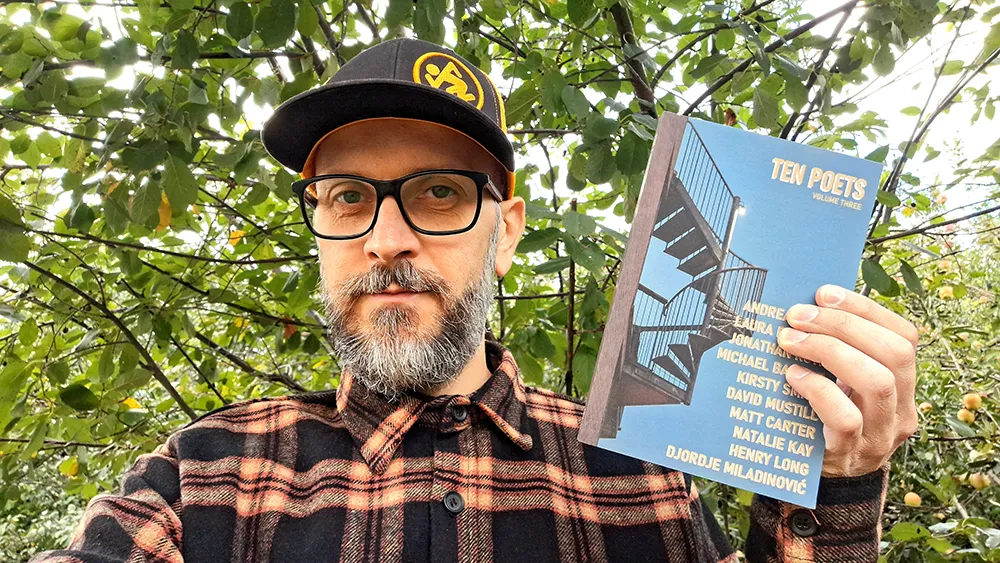
Djordje Miladinović has been a foundational force in underground culture for years, whether running the independent webzine Thoughts Words Action, working closely with independent label Geenger Records, documenting punk rock and counterculture, or performing with various bands. Now, with his inclusion in Earth Island Books’ Ten Poets #3, Miladinović steps forward as a compelling literary voice.
Blending Beat poetry, crime noir, pulp fiction, dark romanticism, avant-garde sensibilities, observational philosophy, and a lifelong DIY ethos, his verse digs into the margins of modern society, examining the human psyche under the pressure of a rabid capitalist framework. We caught up with Djordje to discuss his transition into published poetry, his artistic roots, and the philosophy behind his upcoming standalone collection.
Order Ten Poets #3 HERE
Disclaimer: This interview was curated by journalist Ksenija Mitrović as part of a joint collaboration between Thoughts Words Action and AmpArt Kolektiv. It is published simultaneously across both outlets in print and online formats.
All my life, I’ve been inspired by green anarchism, anarcho-pacifism, anarcho-individualism, and the DIY ethos, and I try to live by those principles as much as modern society allows. That means staying completely dedicated to artistic expression that goes against the grain, resisting the norms imposed by the system, social media, streaming platforms, and influencer culture. I don’t necessarily broadcast explicit political doctrine in my poetry, but I do critique the heavy expectations forced onto modern individuals, the very forces that dictate how we behave, act, and suffer today.
Well, it has been a while since we spoke. I think we went for tea and chatted about books and vinyl records last time. What happened since then?
Yup, it has been a minute. A lot of things happened since we met last time. Lots of work, reviews, interviews, correspondence with authors, musicians, and record labels. Regular stuff…
Being featured in Earth Island Books’ Ten Poets, Volume Three places your work alongside nine other distinct, uncompromising voices from the underground scene. How did it feel when the editors brought you on board for this compilation, and what does it mean to be part of a project that actively levels the playing field between seasoned writers and discoveries?
I was thrilled, obviously. It’s not every day you get picked for an ongoing poetry series, edited by such excellent poets and published by Earth Island Books. It means a lot to me, mainly because Earth Island Books has been an essential hub for punk rock writers for years, and given their incredible catalog, it’s a fantastic opportunity for my poetry to reach new readers and like-minded souls.
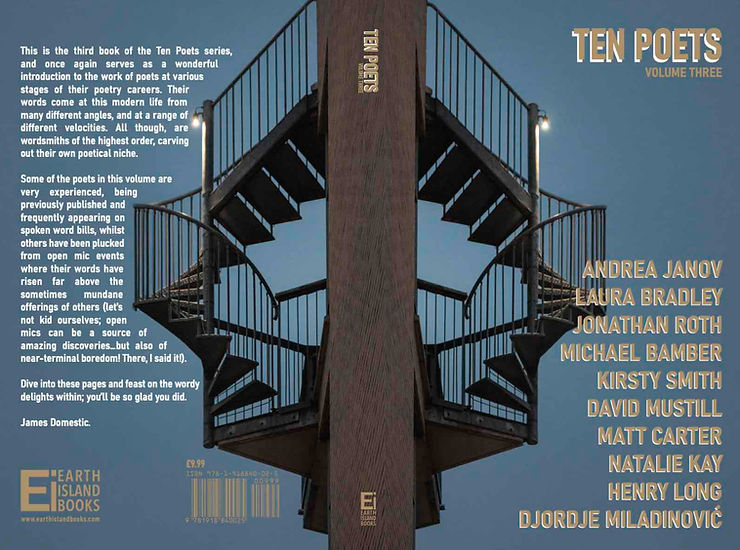
The editorial preface by James Domestic notes that this collection aims to “smack readers in the chops” with direct, unpretentious writing. How do your contributions to the book fit into that ethos, and what central thoughts or feelings were you hoping to convey with your selected pieces?
I firmly believe that Earth Island Books and I share an almost identical ethos. David and I are longtime friends who have collaborated on countless pieces, reviews, and interviews with the bands and authors he’s signed through both Earth Island Books and Engineer Records. Both outlets are true passion projects, fueled by a decades-long devotion to punk rock and counterculture. His dedication to publishing and promoting unheard voices is genuinely inspiring and motivates others to stand up and contribute to the scene.
The batch of work I contributed to Ten Poets #3 deals with marginalized people, those who never stood a chance of surviving the jaws of a rabid capitalist system and a deluded modern society. Through an abstract, illustrative, almost philosophical approach, I question the root causes, obstacles, and hardships that make living in modern society so difficult in the first place. I see my poetry as abstract, observational, and conversational, yet direct at times, offering readers a solid platform to sit back and contemplate everything that weighs on the modern individual.
Your poetry blends free verse, beat-inspired cadences, and raw punk rock poetics. How did you arrive at this specific stylistic direction, and how do you decide when a piece calls for a conversational, observational flow versus a sharp, confrontational rhythm?
Decades spent reading books, zines, and political bulletins have undoubtedly shaped my writing approach. It really comes down to the themes and pacing I want to achieve. There are poems I purposely construct to be raw, aggressive, and unfiltered, while others naturally demand a calm, soothing, and contemplative tone.
There’s a distinct noir, gothic, and countercultural undercurrent running through your writing, peeling back the scabs of everyday life to look at what’s underneath. What draws you to exploring those darker, more shadowy corners of human experience and modern existence?
It has a lot to do with my love for post-punk, goth rock, and dark aesthetics. Bands like Bauhaus, The Cure, Siouxsie and the Banshees, Gang of Four, The Sisters of Mercy, Echo & the Bunnymen, and Low Life, along with writers like Edgar Allan Poe, George Orwell, Bertolt Brecht, and Charles Baudelaire, have all had a massive influence on me, just to name a few. Inspiration is all around us, and we just have to grab it and turn it into something.
A lot of your work deals with the friction of modern life, the absurdity of daily routines, and the grit of the streets. How do you balance social critique and sharp cynicism with moments of genuine vulnerability or catharsis in your poems?
It’s a process that has evolved naturally over the years. My work is shaped by observing everyday struggles, applying an anarchist critique to those issues, and tackling core human emotions at once. Crafting that particular mood doesn’t always happen overnight, but wrestling with the tone is what makes the creative process so rewarding.
You’ve often cited literary figures like Jack Kerouac, Charles Bukowski, Allen Ginsberg, Edgar Allan Poe, and William S. Burroughs as foundational to your mindset. How do those classic Beat, dark romantic, and avant-garde influences bleed into your modern, 21st-century perspective?
Those are just a handful of the writers who inspire me. The full list of authors, poets, and thinkers could go on forever. Naturally, you have to name-drop a few key figures for a press release so readers know what to expect from a new voice, but the truth is every poet carries a massive web of influences. The Beat writers definitely laid a foundation for me, and I took a distinctly Beat approach while crafting this batch of poems, but I could just as easily name dozens of other authors, both underground and well-known, who shaped my work.
Blending Beat poetry, dark romanticism, the avant-garde, punk rock, and jazz can be challenging, but it’s always rewarding. If readers connect with these poems and start picking up on all those subtle layers and influences in my writing, there’s really no better feeling.
With decades of experience performing in hardcore punk and metal bands, and writing about music, sound is clearly in your blood. How does your deep background in underground music directly dictate the rhythm, tempo, and sonic texture of your written words?
I don’t really think about it in the moment while I’m writing, but looking back at a piece later, I always find myself reading my poems with specific rhythmic patterns in mind, and it surprisingly always works out. To me, it’s far more important that the words make sense and tell a clear story first. Once the core idea is assembled properly, the cadence, natural pacing, and overall dynamics just fall into place on their own.
Writing a short, punchy poem shares a lot of DNA with writing a two-minute punk rock track or constructing a noisy, wall-of-sound soundscape. Do you treat page space like a musical track where pauses, line breaks, and cadence act as your arrangement?
Sure, but really only if the poem is meant to be performed at an open mic. I don’t consciously lean on punk rock songwriting structures when writing poetry, mainly because these pieces aren’t meant to serve as song lyrics. For me, poetry is about capturing specific sentiments, moods, and moments in time, creating an immersive atmosphere that stays with the reader long after they’ve finished the page.
The underground DIY scene has always been inherently political, whether through direct action or simple resistance to mainstream sanitized culture. How would you define the political or countercultural stance that fuels your pen?
All my life, I’ve been inspired by green anarchism, anarcho-pacifism, anarcho-individualism, and the DIY ethos, and I try to live by those principles as much as modern society allows. That means staying completely dedicated to artistic expression that goes against the grain, resisting the norms imposed by the system, social media, streaming platforms, and influencer culture. I don’t necessarily broadcast explicit political doctrine in my poetry, but I do critique the heavy expectations forced onto modern individuals, the very forces that dictate how we behave, act, and suffer today.
Academic poetry often feels locked away in an ivory tower, whereas underground poetry is meant to be felt deeply. What has the response been like from readers and fellow scene figures who might not traditionally pick up a formal poetry book, but connect deeply with your raw style?
To be honest, I was deeply surprised and moved by the sheer amount of buzz this release has generated so far. As someone who stepped into the poetry world fairly recently, I was a bit skeptical about how things would turn out, but the response has been incredible. I’ve received so much positive feedback from fellow writers, critics, friends, and acquaintances. As you mentioned, academic poetry still gets a baseline of media coverage, which isn’t really the case for Beat and punk rock poetry today.
Reviews and news coverage are definitely lacking across the board in my opinion, but overall, my debut has been embraced by so many people I admire that I really can’t complain. On the contrary, it fuels me to keep pushing forward and write more.
Word is you’ve been working on expanding your own massive solo poetry collection. How did participating in Ten Poets 3 feed into the momentum of shaping that full-length standalone book?
As I mentioned, the reception for Ten Poets #3 gave me all the motivation and momentum I needed to jump into writing my first full poetry collection. I’m currently working on it, and hopefully, the entire manuscript will be finished soon.
With Ten Poets, Volume Three out in the world via Earth Island Books, what is the next creative chapter on the horizon for you, whether on the printed page, behind a microphone, or within the underground press?
In addition to drafting my debut poetry manuscript, I’m contributing to several multi-author poetry anthologies, writing short fiction for the upcoming Hardcore Horror anthology, and regularly publishing reviews, news, and interviews at Thoughts Words Action.
I already know you won’t stay still. I wish you all the best in your writing endeavours. Would you be so kind as to say something to our readers?
Pause for a moment, take a deep breath, and prioritize what truly matters to you. Never stop reading and creating, even when your audience is just yourself. The world desperately needs more art, and every single poem, piece of prose, painting, or sketch counts. When everything else falls apart, your art remains, a sanctuary to heal a wounded soul. DIY or DIE!
Discover more from Thoughts Words Action
Subscribe to get the latest posts sent to your email.