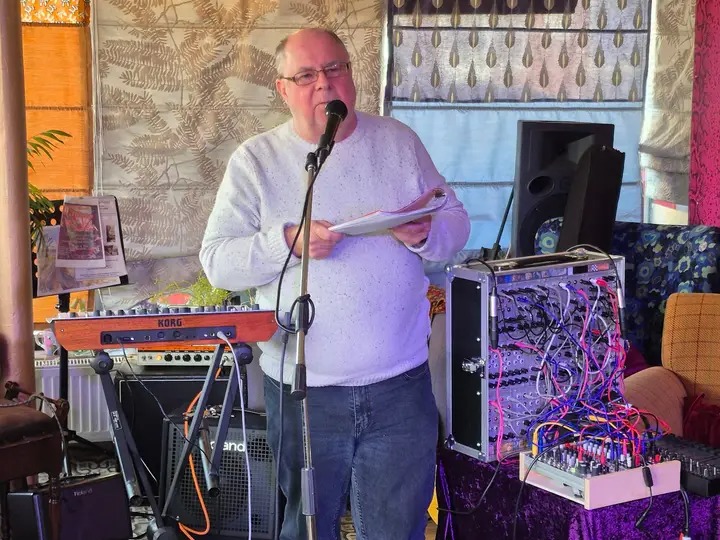
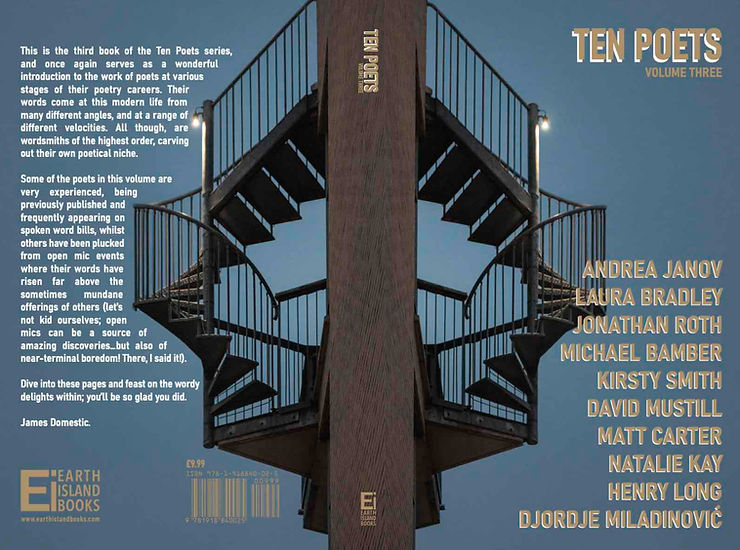
We spoke with poet David Mustill, featured in Earth Island Books‘ Ten Poets #3, to discuss the craft behind his work. In this interview, we dive into his creative process, key inspirations, recurring themes, writing techniques, and the favorite authors that shape his unique poetic voice.
Order Ten Poets #3 HERE
Thank you for taking the time to answer these questions. How have you been?
I’ve been fine, busy and excited. Juggling promoting various poetry open mic sessions I’m involved in running, plus the new Five Poets series of readings I’ve just started organising with fellow Ten Poets Volume Three contributor Michael Bamber. I’ve been most excited about playing synth again at a couple of gigs with Hugh Metcalfe’s Klinker improv collective.
What was the initial spark or catalyst that first drove you to start writing poetry, and how does that early impulse compare to what pushes you to put pen to paper today?
As a teenager I’d written things on and off – a few poems, some song lyrics – but it was a bout of depression in my late twenties that got me writing poetry more actively. I think a lot of people find writing poetry a way to handle disturbing or contradictory thoughts and emotions. I think it helped with me. I wrote a lot for about fifteen years and was very active in the then rather quiet Ipswich poetry scene. Then I pretty much stopped. About fifteen years later, in 2024, my regular drinking buddy told me he was moving to Leighton Buzzard and I thought Fuck ! I’d better find something to do. An old poet friend had been nagging me to go along to one of the local open mic nights. I dug out my old poems and off I went. Best decision my ex-drinking buddy ever made, in my opinion, as I’ve been loving life these past two years. It’s hard to pinpoint what triggers me to write these days, maybe what ifs and incongruities, the wrong person in the wrong place.
How has your background, involvement, or affinity with punk rock and DIY counterculture shaped your approach to poetry, performance, and creative expression?
I was twelve or thirteen when I first encountered punk – an older cousin getting ready for a night out – and it terrified me. I don’t have a great affinity with punk, but improvision and DIY, avant garde art is something that has always grabbed me. I love Krautrock, which grew out of artistic and political rebellion so shares something of punk’s ethos. My poetry tends to be carefully honed but the form is often unconstrained.
Can you walk us through a typical writing session? Do your poems usually start with a sudden line of dialogue, a rhythm in your head, a specific image, or a deliberate theme?
Normally it’s a confluence of two things, the strange combination of person and place, or two emotions at the same time. Often the punchline is in my head and I roll it around for a bit before setting pen to paper. I don’t sit down with the mission of writing a poem. There is a spark and I let it grow a bit.
When you look back at the body of work you contributed to Ten Poets #3, what are the central obsessions, conflicts, or truths you find yourself continuously returning to?
Alienation – from yourself and others knowing you. It is hard to trust. Hard to be honest with yourself and others. There is a lot of regret. Wasted opportunity and time.
Which authors, poets, or underground writers have left the deepest scars on your literary style, and why do they resonate with you so strongly?
Style I don’t know. I admire satire. I perhaps arrogantly think my style is my own but I probably absorbed a lot from attending the Aldeburgh poets festival for well over ten years. Stephen Knight and Jo Shapcott spring to mind. I love John Hegley – all that pain and insight wrapped up in an exquisite tiny package that can look like a throwaway joke.
If you had to pick a single book that changed your worldview or completely altered how you understood the written word, what would it be?
An English teacher recommended two early weird fiction books (possible in the same lesson that he recommended taking acid) – The Purple Cloud by M. P. Shiel and A Voyage to Arcturus by David Lindsay. The second of these made me realise that not everyone sees, or can see, the world the same way as me. We all view the world differently.
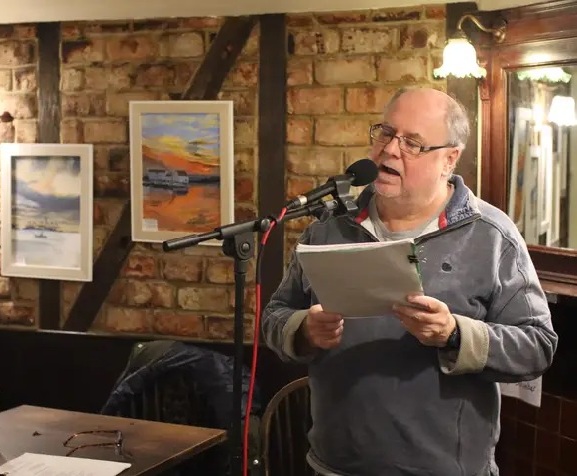
Many punk-associated poets write with a distinct spoken rhythm in mind. How do you balance how a poem feels read silently on a printed page versus how it hits when spoken out loud?
This is difficult as most of my poems lack a regular rhythm. I have some poems that I would not put in a book because they should be read with pauses and emphasis that it is hard to represent on paper. There should be a way of writing poetry so that it can be read as the poet intended, like verbal sheet music.
Writing and independent publishing in the underground scene often comes with its own unique hurdles. What keeps you motivated to keep creating and sharing your work in a climate that often overlooks poetry?
I’m much more interested in performing than in being published. What motivates me is the wonderful people I’ve met since getting back into poetry. There are so many different events these days, and we keep making new ones.
Without giving too much away, is there a particular piece of yours featured in Ten Poets #3 that holds a heavy personal weight, or has a specific backstory behind its creation?
ThreeBuses means a lot to me. It is about lost opportunities and friendships, and repeating the same mistakes. More Dreams to Help The Lives of Fishermen was inspired by waking up to go for a pee one night. I’d awoken from a wonderful erotic dream and as I was getting back into bed I thought it would be great to slip back into it. Then the thought occurred to me that wishing for such a dream was selfish and I should wish for dreams of a more altruistic nature, like helping the poor fishermen. Out of that thought came the poem.

Now that this collection is out in the world via Earth Island Books, what is next on the horizon for you creatively? Are there broader writing projects, chapbooks, or performances we should look out for?
I am half thinking of putting a poetry collection together and getting it printed but I am primarily motivated by performing. Michael Bamber and I are starting a series of poetry nights in Ipswich that will give five poets a chance to do a twenty minute set rather than the usual five minute open mic slot. The first of these is on 7th September at Bin93 Wine Bar in Ipswich and the second is on 16th November.
That’s it. Thank you for your time. Anything you would like to say to our readers before we wrap this interview?
Find a local poetry open mic night and join in or listen – poets are friendly.
Discover more from Thoughts Words Action
Subscribe to get the latest posts sent to your email.