
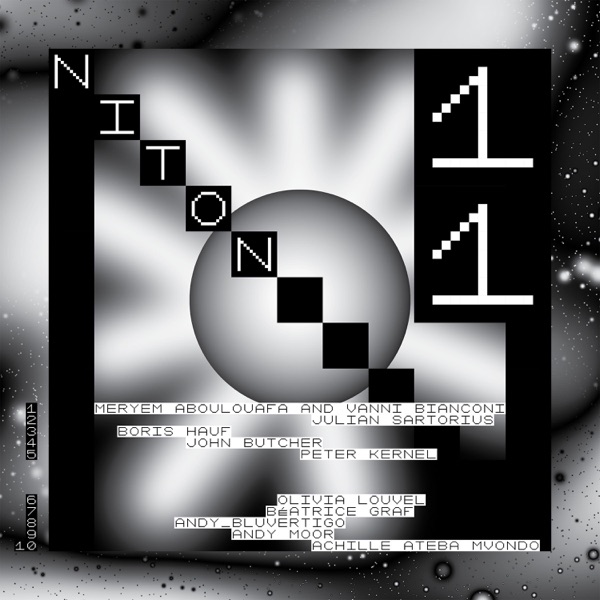
With 11, their fourth album, Niton has crafted a profoundly immersive, boundary-pushing collection of experimental electronica that celebrates their ten-year journey while pointing toward a future of even broader sonic exploration. The Italian-Swiss trio—Zeno Gabaglio (electric cello), Luca Xelius Martegani (analogue synthesizers), and El Toxyque (amplified objects), have long been known for their unconventional approach to sound. On 11, they go further, collaborating with 11 international artists to weave an intricate collection of rhythms, melodies, and textures that challenge traditional notions of electronic music.
Right from the outset, 11 immerses the listener in an otherworldly soundscape, where rhythmic sequences are less beats and more carefully layered sonic architecture. Every moment feels carefully constructed yet alive with spontaneity, a perfect example of their ability to meld experimental roots with a newfound maturity. This duality, a sense of control juxtaposed with wild creativity, makes the album endlessly compelling. Henning Schmitz of Kraftwerk, who mastered the record, ensures that each nuance is audible, giving the album a clarity that enhances its complexity. The rhythmic sequences are astonishing in their detail and precision. Rather than simply anchoring the tracks, the rhythms shift and evolve like living organisms. Gabaglio’s electric cello plays a pivotal role, adding an organic quality to the mix. Whether plucked, bowed, or manipulated electronically, the cello becomes a shapeshifting element, integrating with Martegani’s analog synths and Toxyque’s amplified objects. These layers don’t just sit atop one another, they interact, push, and pull, creating a dynamic sonic ecosystem.
The melodies feel almost alien at times, yet they resonate on an emotional level. Themes emerge and dissolve like fog rolling over a landscape, offering glimpses of beauty amid the chaos. Some passages lean into ambient minimalism, while others explode with avant-garde intensity, pushing the boundaries of what electronica can be. The album’s collaborative spirit shines brightly. Niton’s decision to bring in eleven guest artists infuses the record with a richness and variety that elevates it to a new level. Brass sections on certain tracks add a bold, cinematic quality, punctuating the otherwise abstract compositions with moments of grandeur. Vocals, used sparingly but effectively, bring an entirely new dimension to the music. Ethereal and haunting, they feel like echoes from another realm, grounding the album’s experimentation in something deeply human.
One of the most intriguing elements of 11 is its subtle nods to world music. Percussive patterns and tonal themes borrow from ethno traditions, weaving them into the fabric of the album without ever feeling derivative. These influences, whether intentional or intuitive, add an earthy grounding to the album’s more cerebral explorations. The result is a sense of universality as if Niton is tapping into the primal language of sound itself. The production is impeccable, with every sound finding its rightful place in the mix. There’s a spaciousness to the record that allows its intricacies to breathe. The interplay between analog and digital elements is outstanding and it exemplifies their skills as musicians and producers. Each track feels like its own self-contained world, yet together they form a cohesive, challenging, and rewarding journey. Lyrically and thematically, 11 feels like a meditation on time, transformation, and collaboration. While the music itself doesn’t offer explicit narratives, the presence of 11 collaborators feels symbolic, a reflection of Niton’s journey and their willingness to open their creative process to outside voices. The album’s structure mirrors this idea, with its fluid transitions and interconnected motifs suggesting a larger whole greater than the sum of its parts.
11 is a treasure trove for all experimental electronica and avant-garde music fans. It channels the spirit of pioneers like Brian Eno, Aphex Twin, and Autechre while carving out its own distinct identity. At the same time, it doesn’t alienate the listener with its complexity, instead, it invites curiosity, rewarding those who are willing to engage with its intricacies. The album also holds appeal for fans of ambient and post-classical music, as its cinematic scope and emotional resonance transcend genre boundaries. 11 is a landmark achievement, a daring exploration of sound that pushes the limits of what electronic music can be. It’s an album that challenges, inspires, and captivates, offering a deeply personal and universally resonant listening experience. You should immediately place this electronic music gem on your radar. Don’t miss it!
 Thoughts Words Action