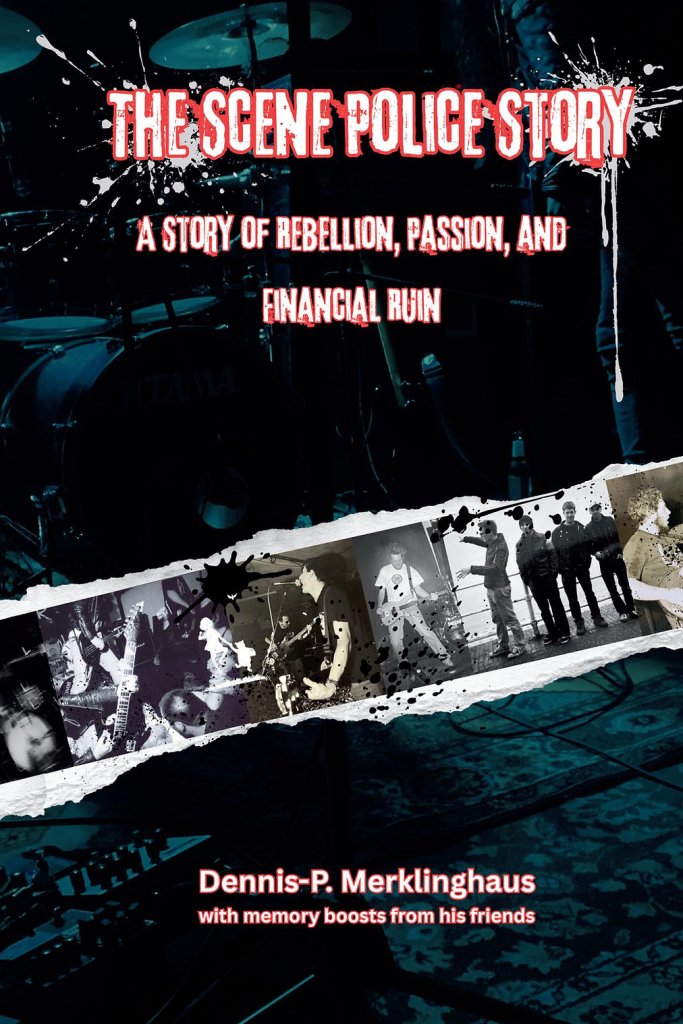
Let’s be honest for a second, most books about punk rock tend to fall into two unbearable traps. They’re either sterile, academic treatises written by folks who watched the movement through a telescope, or hyper-romanticized memoirs where every broken tour van and empty squat gets retrofitted with a cinematic halo. We love the mythologies, sure, but real underground culture rarely looks like a slick documentary. It’s loud, smelly, financially ruinous, and usually fueled by equal parts burning conviction, cheap coffee, and chronic sleep deprivation. And that’s why The Scene Police Story hits like a ton of bricks. It completely bypasses glossy self-congratulatory nostalgia and offers raw, warts-and-all confession from the frontlines of independent record label operations and DIY touring. It is a war story, love letter, and autopsy report, all rolled into one fast-paced narrative.
The premise begins with a familiar itch. Born out of sheer frustration with scene elitism, hyper-politicized gatekeeping, and moral posturing, Scene Police started as a spontaneous middle finger to the status quo. What was meant to be a collective reaction mutated into an international underground juggernaut spanning a record label, an international tour booking network, mailorder distribution, and a full-time obsession that devoured six years of life. If you’ve ever run a small label or booked DIY gigs, the early chapters will trigger a heavy dose of sympathetic anxiety. The story details how a passion project quickly spiraled into a 24/7 operation. Over its six-year lifespan, Scene Police churned out 40 releases, records that didn’t just fill distro boxes, but genuinely shaped the sonic landscape for thousands of listeners across Europe, the UK, North America, and Japan. They weren’t churning out safe, commercially proven hits, but were putting out records nobody expected, yet somehow everybody ended up loving. This showcases the interconnected web that touches landmark names and underground lifers alike. The text threads through anecdotes and working relationships with titans like Hot Water Music, Planes Mistaken For Stars, Strike Anywhere, and Tiger Lou, even stretching out into unexpected encounters with rock ‘n’ roll icons like Motörhead.
But the book never treats these name-drops as cheap badges of honor. Quite the contrary, they serve as proof of how surprisingly tight-knit the global underground really is when built on mutual trust and shared ethics. Crossing borders with gear stuffed into questionable vehicles, navigating customs without proper permits, and relying on the generosity of strangers in foreign cities, these stories capture an era where community wasn’t an abstract marketing buzzword, but an essential survival mechanism. DIY culture often hides its scars, preferring to talk about the victories while quietly sweeping the catastrophic bank statements and emotional fallout under the rug. This book refuses to do that. It dedicates a substantial portion of its narrative to the inevitable collision between rigid idealism and cold, hard reality. Running an operation on passion alone is a noble sentiment, but when bad financial decisions compound, mail-order debts mount, and political infighting brews within the collective, the foundation inevitably cracks. The narrative dives deep into the suffocating weight of burnout, the ideological screaming matches, the physical exhaustion of sleeping on cold venue floors, and the bitter realization that heroic ambition cannot pay a pressing plant bill. After six relentless years and 40 records, Scene Police collapsed under its own weight. But rather than framing this ending as a tragic failure, the narrative embraces it as a natural, albeit painful, conclusion. It demonstrates that a label’s lifespan shouldn’t be measured by its financial longevity, but by the unforgettable mark it leaves on the culture and the people who inhabited its orbit.
Stylistically, the book reads with a breezy, conversational rhythm that feels like sitting with a close friend and sharing stories long after the headliner has loaded out. The prose is sharp, humorous, and devoid of pretension. It’s deeply analytical about the mechanics of underground music while remaining entirely accessible to casual readers who might not know the difference between a test pressing and a flexi-disc. You can practically taste the stale beer, smell the exhaust fumes of a broken-down Ford Transit, and feel the cardboard dust from hundreds of record shipping boxes. It captures the sheer tactile beauty of physical media and human connection in an era before everything was reduced to algorithms, streams, and social media metrics. The Scene Police Story is practically a warning label against ever attempting to run an independent record label if you value your sanity or bank account. But more importantly, it is a brilliant, essential example of how we all bother caring about punk rock in the first place. It’s a book for anyone who ever hauled heavy speaker cabinets up narrow staircases, slept in moldy basements, argued politics until sunrise, or believed that creating art with your friends was worth every single penny lost. Scene Police may be gone for decades, but the music remains, the friendships endure, and now they’re back with new records slated to be released soon. Still, this book stands as definitive proof that for six chaotic years, DIY punk was as real, raw, and vital as it gets. Head to Earth Island Books for more information about ordering the book.
Discover more from Thoughts Words Action
Subscribe to get the latest posts sent to your email.