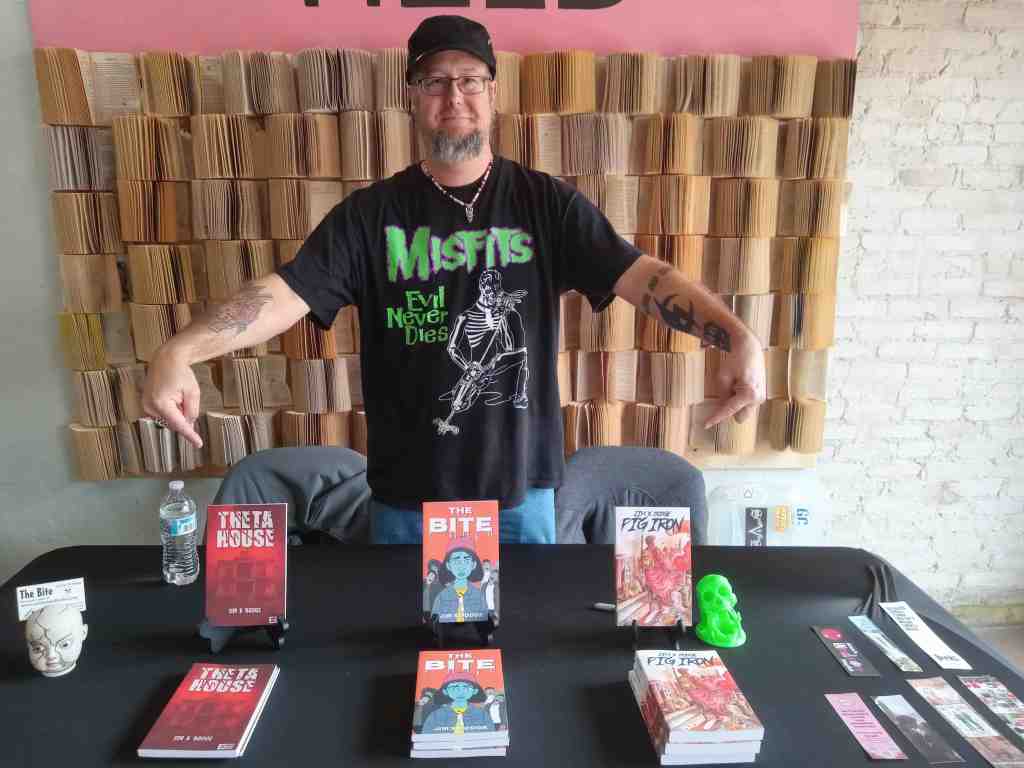
We sat down with Tim Cundle, an author, curator, and the driving force behind the legendary Mass Movement webzine and podcast, to dive into Hardcore Horror, the horror anthology written by punk rockers and published by Earth Island Books. In this interview, we explore the origins of the project, his work curating and contributing to the collection, his core inspirations, and the recurring themes that bind the worlds of punk rock and horror fiction together.
Order Hardcore Horror HERE
How did you first get into horror? Do you remember the very first horror book or movie that truly terrified you?
Tim: I picked up a novel, Dagon & Other Stories off my parents’ bookshelf when I was about nine or ten, and lost myself in the dark, stygian cosmic horror crafted by H. P. Lovecraft during a long, school Summer holiday. I think I read it four or five times in a row, and instantly became a devotee of things that go bump in the night.
As for the first movie that scared me, that would have been Jaws, which I saw sometime around 1981 when my dad rented it from a video store. The raw power of nature, and not knowing what lurks beneath the surface of the ocean, has played havoc with my imagination ever since.
Over the years, which horror authors, directors, or artists have had the most tremendous impact on your creative sensibilities?
Tim: Probably John Carpenter, Christopher Golden, and Stephen King, who are all masters at creating incredibly real, character driven microcosms within the banal, everyday whole. Trying to choose between them is nigh on impossible, as they complete the unholy triumvirate that constantly makes me think that maybe, just maybe, one day I’ll write something that comes close to their work. You have to have a dream, right?
Hardcore Horror brings together voices from the punk, hardcore, and alt-rock communities. What do you think is the connective tissue between the underground music scene and the horror genre?
Tim: They both reject mainstream ideology and thrive on the creativity of their participants. They’re also part and parcel of outsider culture, and appeal to the misfits and underdogs who don’t fit in with the bland and insipid literature, art, and music that mainstream culture is built on. And, both punk and horror like to push the limits of creativity to their absolute limit, and force their audiences and participants to question themselves and the world around them. Which is kind of nice.
Turning to your specific contribution to this Earth Island Books anthology, where did the initial spark or inspiration for your story come from?
Tim: Honestly I just wanted to write a Lovecraftian style story set in space, that was maybe a little more grounded than most grandiose Sci-Fi, and drew from the history of the Cthulhu mythos, that also paid tribute to some of the pulp authors, like Robert E. Howard and Golden Age of Science Fiction writers, like Robert Heinlein and Ray Bradbury that I adore.

Without giving away any major spoilers, what are the core themes or underlying fears you wanted to explore in this piece?
Tim: Probably that the Universe is a monstrous entity filled with dread and all manner of darkm unforgiving, ancient things, and that humanity is nothing more than a blip on the radar of cosmic history. That, and the fact that I wanted to write a good old fashioned, pulp style story.
How did your story evolve from the first draft to the final version, and what was the experience like working on it?
Tim: I had the idea fleshed out in my head for a while, so it ran through three drafts before a final edit. The main issue I had was cutting it down to the required length, as the initial draft of the story ran to close to sixty-five thousand words, and was more akin to a novella than a short story, and it took me a while to figure out how to make it work in a condensed format. I hope I did the idea justice and that people like it…
What was the most challenging aspect of writing this particular story? Was it nailing the ending, writing a specific terrifying scene, or something else entirely?
Tim: Trying to figure out the ending without making it too bleak or too hopeful was slightly problematic, and all the stuff in the middle, that is the story itself, took me some time to figure out before I started writing it.
When it comes to your writing process, how do you approach crafting a short horror story? Are you a detailed outliner, or do you let the narrative unfold organically?
Tim: I plot things out. I know where I want a story to go, and how it should get from the beginning to the end, and then sit down and write it. The problem is, as most of my stories unfold, they take on a life of their own and very rarely turn out the way I originally thought they would, and hope that they will. I’m not sure whether that’s a good or a bad thing, but at this point I’ve surrendered myself to the fact that it is what it is.
Horror relies heavily on pacing and atmosphere. What techniques do you use to build tension and a sense of dread on the page?
Tim: I just stomp on the literary gas and go all out. As you said, horror is all about pacing, and building dread, and I’ve always been a fan of the former far more than the latter. While I appreciate the slow burn, and gradual build, by necessity, with a short story you don’t have time to waste, and given my literary style, I just like putting my foot down and redlining the plot to see where it eventually takes me, and the story.
How do you approach character development in a short format, ensuring that the reader cares about the protagonist before the horrific elements take over?
Tim: A far wiser person than I will ever be once said that you write what you know. Characters have to be believable within the context of the story, and the framework that they exist in, so I tend to gravitate more toward creating characters that the reader can invest in, and get behind, as those characters worlds fall apart around them.

Horror as a genre is incredibly vast and constantly evolving. What are your thoughts on the current state of horror literature and cinema?
Tim: I tend to favour thirties, fifties, seventies, and eighties horror films, and am a big Amicus, Universal Monsters, and Roger Corman fan. That said, I am more than a little smitten by Mike Flanagan’s works and the series that he creates, like Midnight Mass. As for horror literature, there are some incredible writers working in the genre, like Stephen Graham Jones, Christopher Golen, Tananarive Due, whose books constantly amaze and astound me, and I’d recommend that anyone and everyone read.
If you had to recommend one essential horror book and one essential horror movie, what would they be?
Tim: Oh, jeez… An American Werewolf In London, as I think it’s the greatest horror film ever made, and manages to compress humour, nightmare scares, monster mythology, and a rip roaring plot into a less than one hundred minute rollercoaster ride. Plus, Rick Baker’s special effects in the film still blow me away, and that transformation scene is probably one of my favourite scenes in any film, ever.
As for books, that honour belongs to my old pal Weston Ochse’s SEAL Team 666 trilogy that combines monsters, conspiracies, and high octane action. I can’t tell you how many times I’ve read them, they’re that good. And it breaks my heart that Weston passed away so young, as not only was he an incredible writer who hadn’t even begun to tap into his potential, he was a good man and even better friend, who I miss dreadfully.
What is next for you? Are there any upcoming books, projects, or other creative endeavors we should keep on our radar?
Tim: Well, we’re (that is a bunch of writers and myself), working on Hardcore Horror Vol. II , and I’m in the middle of writing a new novel, which I hope will see the light of day sometime in the next eighteen months. Oh, and everyone should check out Mass Movement Presents, the geek centric, punk fuelled podcast that my friend Chris and I put together, For some reason, it’s in the top twenty percent of most listened to, and followed, podcasts on Spotify. I have no idea why, but it’s nice to know that like minded folks enjoy listening to a couple of middle aged malcontents…
Finally, what is the one wavering thought or feeling you hope readers take away after finishing your story in the anthology?
Tim: That they like it, don’t take it too seriously, and maybe after reading it want to go and check out some of the pulp masters like Lovecraft, Howard, and Heinlein, and lose themselves in the rich worlds and stories that they created.
Pick up a copy of Hardcore Horror here
Discover more from Thoughts Words Action
Subscribe to get the latest posts sent to your email.