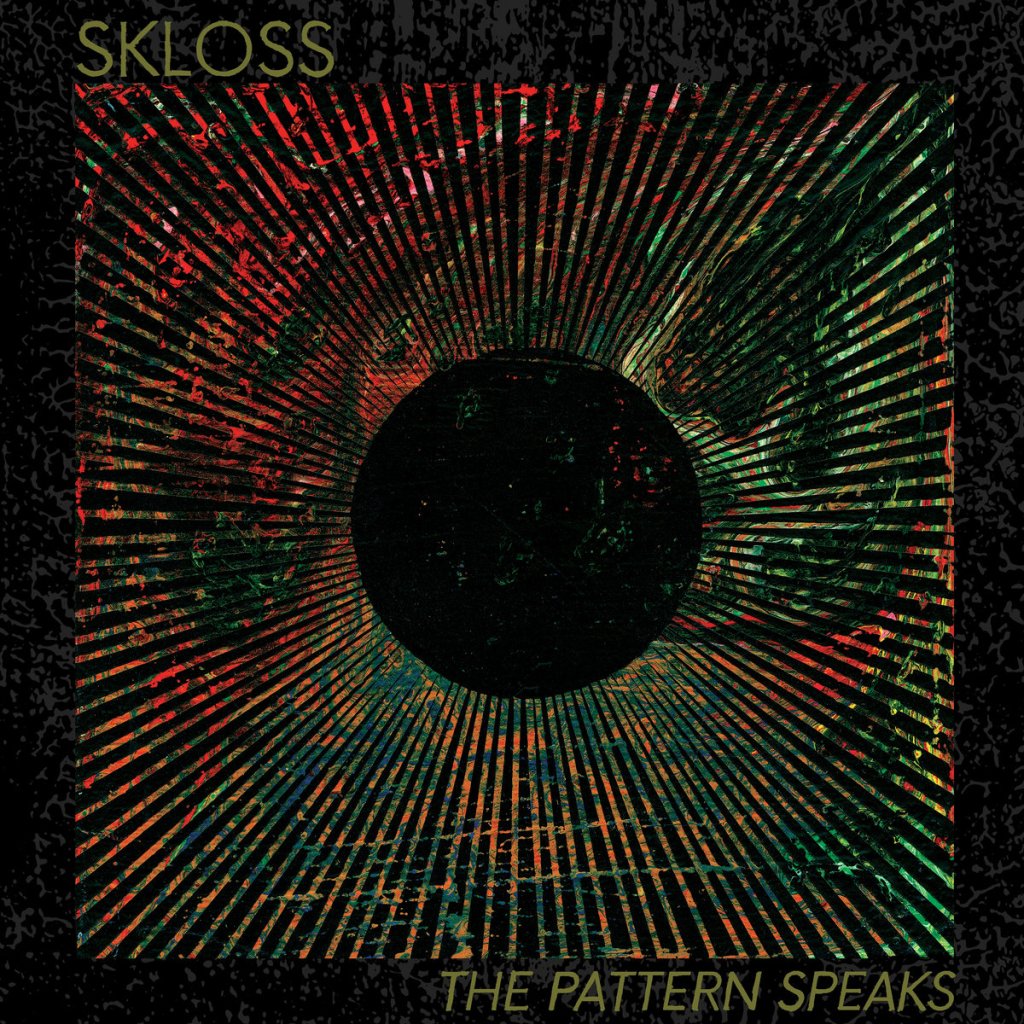
The Pattern Speaks by Austin/Glasgow duo SKLOSS is a record that transcends the tropes of post-metal, psych, doom, and shoegaze, while simultaneously harnessing their heaviest virtues, resulting in an immersive, at times pulverizing, yet often startlingly beautiful listen. It is, quite frankly, one of the most distinct and emotionally resonant heavy records of recent years. SKLOSS, the pairing of Karen Skloss (of Moving Panoramas) and Sandy Carson (of Iglomat), has arrived with a fully-formed vision, a sonic architecture built not from genre allegiance, but from a raw, almost primal compulsion to confront chaos through sound. And yet, for all its ferocity, The Pattern Speaks is significantly controlled. It’s a record of deliberate tension, the weight of distortion offset by moments of disarming clarity, the roar of amplifiers tempered by vocals that drift like ghost signals through the thick fog of sound. To call this “metalgaze” or “spacegaze,” terms the band flirt with, or slyly invent, acknowledges the album’s refusal to sit still. It is unquestionably heavy, but not in the blunt, monochrome sense. The heaviness here carries dimension. It’s textured, layered, and constantly evolving. This is music that swells and breathes, coiling like a living thing. It is doom-laden yet melodic, psychedelic yet concise, confrontational yet meditative. One moment you’re adrift in a narcotic drift of reverb-drenched guitars, and the next, you’re crushed beneath tectonic slabs of drone and feedback. And throughout it all, the interplay between Skloss and Carson feels intuitive and focused.
The album was born in the crucible of pandemic isolation, recorded between Austin and Glasgow during lockdown, and it carries the unmistakable imprint of that era’s psychological strain. But rather than wallowing in despair, SKLOSS weaponizes it. The result is catharsis, pure, loud, and transcendent. Charles Godfrey’s production deserves particular mention. He perfectly captures the scale of SKLOSS’s sound. Each layer is given room to breathe, yet the cumulative effect is monolithic. Drums thunder and lurch like storm systems, guitars stretch to the edge of audibility, humming with feedback and fuzz, and vocals are threaded through the mix like ghost-lit threads. It’s a record that feels vast without ever becoming overindulgent. Lyrically, The Pattern Speaks operates with the same balance of opacity and haste. Rather than offering literal narratives, the lyrics suggest emotional states, anxiety, confrontation, and transcendence. There’s a vulnerability under the distortion that’s impossible to miss. Themes of boundaries, personal autonomy, and psychological fragmentation emerge through repeated listens, often carried by Skloss’s ethereal vocal lines, which hover somewhere between a whisper and a rallying cry. Carson’s grittier delivery adds counterpoint, giving the duo a duality that deepens the emotional register. The album also builds a coherent atmosphere without being static. There is a compositional intelligence to these songs, the flow that resists linearity. Tracks swell from minimal beginnings to devastating climaxes, only to dissipate again like heatwaves off the asphalt. The effect is hallucinatory, a slow-motion detonation stretched across forty-some minutes. The pacing is impeccable. Even at its most restrained, the record hums with potential energy, like a coiled spring waiting to explode.
Though the individual songs are best experienced in sequence, it is worth noting how SKLOSS orchestrates their dynamics. They are masters of the slow build, the delayed gratification. Riffs emerge from a bed of ambient noise or skeletal rhythms. Vocals enter late, as if reluctant to intrude, then suddenly command the space. This restraint lends each sonic eruption more power. It’s a technique that recalls the structural discipline of post-rock but imbued with a darker, more corporeal edge. Indeed, comparisons to bands like Earth, Nadja, or even Swans are not out of place, but SKLOSS are no mere descendants. If anything, The Pattern Speaks feels like a natural evolution of those influences, leaner, more concise, but no less potent. There is an austerity to the songwriting, a refusal to clutter, that lends the record an unusual clarity. It is heavy music as a form of precision engineering, not cold, but razor-sharp. It’s the sound of anxiety made corporeal, of tension rendered in voltage. It might be cosmic, but it is never disembodied. SKLOSS keeps the listener grounded, even as the music spirals outward into the vast unknown. It is a record of unresolved tensions, liminal states, and blurred boundaries. It speaks in patterns rather than declarations. It suggests that chaos has form, that noise contains beauty, and that distortion when wielded with intent, can be both destructive and regenerative. This is not a debut that asks politely for your attention. It is a debut that arrives like a weather system, overwhelming, intricate, and impossible to ignore. With The Pattern Speaks, SKLOSS released a compelling first album that demands your utmost attention. If there is such a thing as spiritual sludge or contemplative doom, this album exemplifies it. Head to Fuzz Club for more information about ordering this gem on vinyl.
 Thoughts Words Action