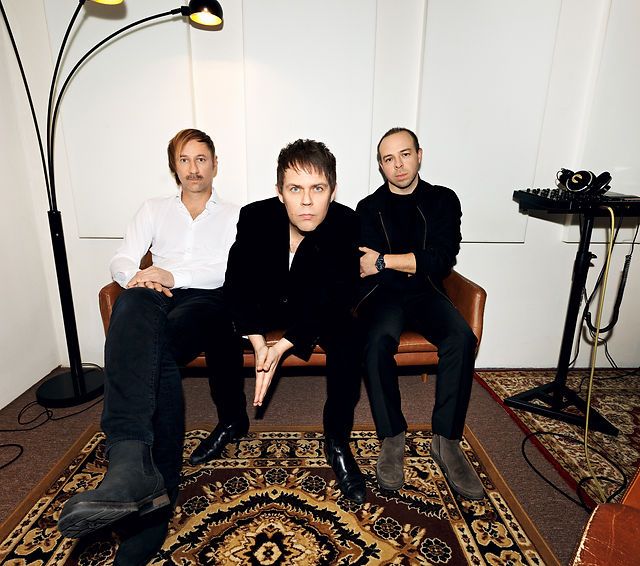
Austrian three-piece zeronic recently returned with their comeback single “The Hope and the Enemy,” marking the band’s first new material in years. Building on that momentum, they today announce their forthcoming album Modernism, arriving October 2nd, 2026.
zeronic’s Modernism is a record about life in an age of constant progress: the freedoms it promises, the uncertainties it creates, and the ways people continue searching for connection within it. Across ten songs, the album explores the tensions that define contemporary life — between closeness and distance, belonging and escape, optimism and disillusionment. Rather than rejecting modernity, it reflects on its contradictions, finding both possibility and unease in the world we’ve built around ourselves.
“Modernism is about trying to remain human in a world that’s constantly being optimised” zeronic add “The songs explore the tensions of modern life—connection and isolation, progress and disillusionment, belonging and escape. But beneath those ideas, it’s really a record about people trying to hold on to what matters and find one another.”
Written over the course of a year, Modernism consists entirely of new material. Around twenty-five songs and demos emerged during the process, with ten ultimately forming the final record. The songs arrived naturally, and the album’s musical identity revealed itself early on. There was a sense of openness and momentum throughout the writing and recording process that felt closer to the spirit of the band’s earliest work than it had in a long time.
Musically, zeronic’s Modernism moves between immediate, guitar-driven songs and more expansive arrangements, drawing together the immediacy of the band’s early work with the broader sonic palette developed across its later records. While its themes are rooted in the realities of contemporary life, the album is ultimately less concerned with technology or progress themselves than with the people living alongside them. At its heart, Modernism is about the ways people continue reaching for one another in an increasingly complex world — and the possibility of finding comfort and hope despite its uncertainties.
From the intensity of “The Hope and The Enemy” to the hopeful nature of “A String of Luck,” each song arrives with its own message and emotional perspective. At the centre of Modernism, however, sits focus track “Heads Down,” a restless, guitar-driven song that explores the disconnect between the pace of contemporary life and our ability to keep up with it.
The track paints a picture of life in the city — surrounded by people, constantly moving, yet increasingly disconnected from the world around us. Its up-tempo guitars and insistent momentum mirror that sense of motion, while the image of “living in the cities with our heads down” becomes a reflection of how easily we can become absorbed in comparison, routine and the pressure to keep moving forward.
“‘Heads Down’ is about that strange feeling of constantly moving without knowing if you’re actually getting anywhere. We compare ourselves, try to keep up, and somehow become part of the very machinery that wears us out.”
Musically, the track captures the directness and energy at the heart of zeronic’s sound, while its themes connect closely with Modernism’s wider exploration of what it means to remain connected in an increasingly demanding world. Beneath the urgency of the song is a simpler question: if we’re all moving forward, are we actually getting any closer to where we want to be?
zeronic’s roots trace back to the 1990s, when the band became one of the defining names of the Austrian alternative scene. Formed by musicians who relocated from a rural upbringing to Vienna, the group’s early need to build an audience from nothing shaped the emotional, euphoric character that still runs through their music today.
By 2000, zeronic had opened for Bryan Adams in front of more than 10,000 people at Graz’s Liebenau Arena. Their 2001 debut, High Life, produced a major radio hit that brought them an Amadeus Austrian Music Award nomination. The band went on to release further albums, tour widely across Austria and Germany, work with producer Gareth Jones (Depeche Mode, Nick Cave), and share stages with acts including New Order, Queens of the Stone Age, Stereophonics, and The Kills — building a reputation that reached well beyond Austria.
Following a lengthy hiatus, frontman Mik Tanzos pursued a solo career, first as MIK and later as TANZOS, earning international airplay and drawing comparisons to David Bowie and Michael Hutchence along the way. He now returns with zeronic for a new chapter — not a comeback, but a continuation, bringing the emotional directness of the band’s early work together with an artistic identity refined over decades.
Discover more from Thoughts Words Action
Subscribe to get the latest posts sent to your email.