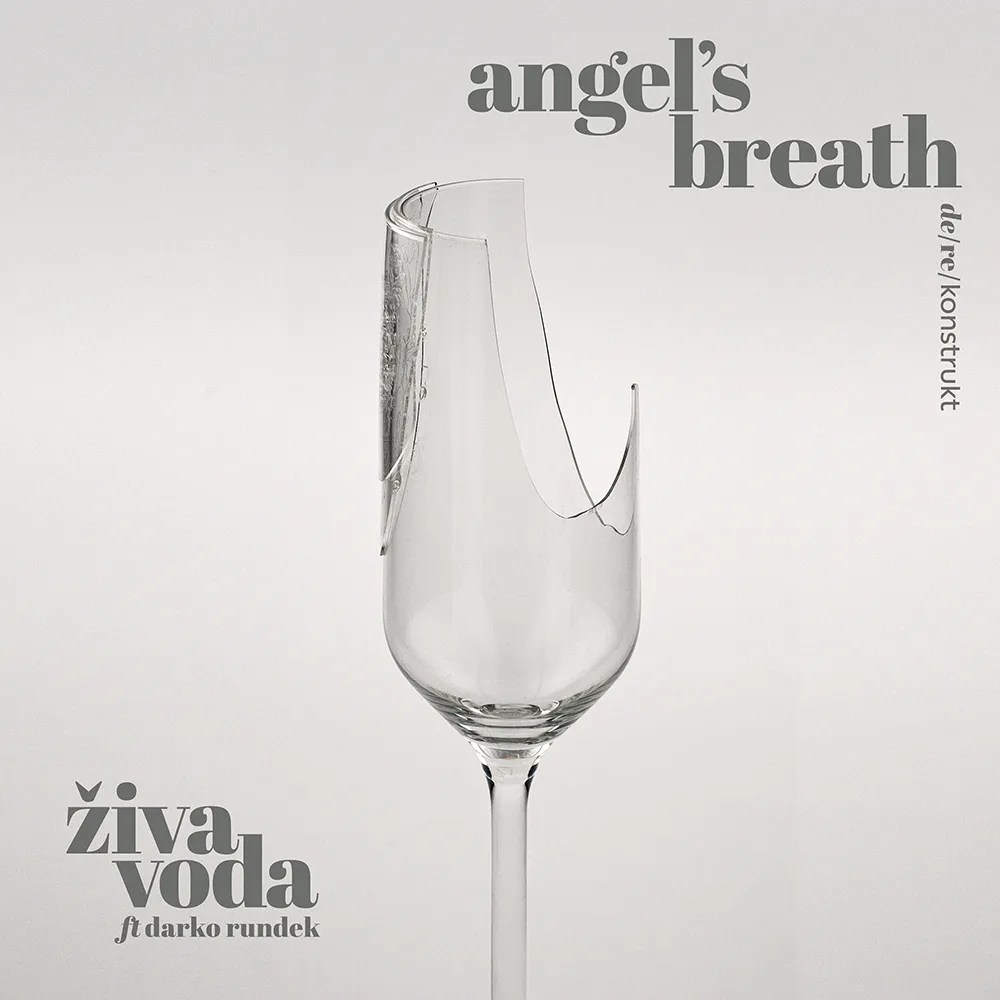
Anyone even remotely into listening and collecting music knows that some records disappear into time while others shape time in their absence. Angel’s Breath, the brief, shining collaboration between Milan Mladenović and Mitar Subotić Suba, recorded in Brazil in the early 1990s, is one of those untouchable artifacts. It flashed once, almost unnoticed, before vanishing into the static of history. For those who discovered it later, it became not just a cult favorite but a kind of whispered mythology, a strange departure from everything expected, even from two artists already known for pushing boundaries. Now, thirty decades later, Angel’s Breath de/re/konstrukt, a full-length reinterpretation by Zagreb-based improvisational collective Živa Voda featuring Darko Rundek, brings that myth into the present, but altered, expanded, and alive in ways no one could have predicted. To call this album a “tribute” would be far too limiting. This is not nostalgia nor a homage in the usual sense. Instead, it’s an act of creative transformation, a deconstruction and reconstruction of an album that was itself a radical break. Where the original Angel’s Breath sought new ground between ambient Brazilian textures, fractured pop forms, and post-Yugoslav longing, de/re/konstrukt uses improvisation to ask entirely different questions: What remains when a song is taken apart, and what new language emerges when its soul is given new interpreters?
Živa Voda, formed in 2017 by Maja Rivić, Mak Murtić, and Vedran Peternel, is not a band in the usual sense but a shape-shifting collective. Its essence is improvisation, not as a stylistic choice, but as a philosophy. Over the years, they have interpreted the work of Haustor, Urban, Imamović, and others, always operating at the tension point between reverence and risk. That duality is precisely what makes de/re/konstrukt so compelling. It honors the delicate strangeness of the original Angel’s Breath, but it also opens it up, unravels, mutates, scatters, and recombines in unexpected configurations. Darko Rundek, a key figure in the original Yugoslavian new wave as a leader of the legendary Zagreb-based group Haustor, and one of Milan Mladenović’s contemporaries, serves as a medium for reimagining emotional weight. His contributions as vocalist, guitarist, and presence carry the serene authority of lived memory. Recorded live at Club Dva Osam in Zagreb, de/re/konstrukt is not polished in the studio sense. Every instrument feels present in the room. Maja Rivić’s vocals inhabit the emotional spaces left by Milan and Suba. She doesn’t imitate Milan’s delivery, as she doesn’t need to. Her voice moves differently through these compositions, shifting between spoken word, extended techniques, and whispered refrains.
The rest of the ensemble is equally vital. Igor Pavlica’s trumpet work, lyrical and disruptive, threads through the record like a question mark. Konrad Lovrenčić’s bass holds a deep, elastic pulse, grounding the improvisation even when the form threatens to disintegrate. Jakša Perković’s guitar offers texture and contrast, sometimes sharp and angular, sometimes submerged in delay. Mario Petrinjak’s percussion leans more toward color than rhythm, while Vedran Peternel weaves found sounds, keys, and archival recordings into a layered, tactile sonic field. Fragmented interview snippets from Milan and Suba drift in and out, not as nostalgic artifacts but as ghostly anchors, pulling the listener deeper into the history the record celebrates and disrupts. The refusal to offer clarity makes de/re/konstrukt even more extraordinary. It does not attempt to “finish” the Angel’s Breath story. It does not flatten its ambiguity. Živa Voda just amplifies its importance as it allows silences to stretch, dissolving the initial structure. They take what was once a song and hold it open, like a window, and in doing so, they reveal the nature of re-interpretation itself.
It is a reimagination that dares to remember without idealizing, to explore without mapping. There are moments of undeniable beauty where Rivić and Rundek’s vocals merge in spectral harmony, Pavlica’s trumpet blooming suddenly into melodic transparency, a groove arising from the mist only to vanish again, but there are also moments of dissonance or confrontation. The album invites discomfort as much as reverie, and it’s less a sanctuary and more like a séance. Much has been said about Angel’s Breath as a symbol of lost potential, of what Milan Mladenović and Mitar Subotić might have created had fate allowed, but de/re/konstrukt doesn’t treat their work as sacred relics. It treats them as seeds. The music here is not static. It pushes outward, and it engages with Milan and Suba not as legends but as fellow travelers, curious, open, hungry for what comes next, and perhaps that is where the true genius of this album lies. de/re/konstrukt offers a living, breathing, imperfect act of devotion. It doesn’t remake Angel’s Breath as it was, but as it might be and as it might become. With its slashes and fragments, de/re/konstrukt, the title suggests that reconstruction requires destruction, memory is not linear, and that music, like water, must move or stagnate. Živa Voda has given us a process, an invitation to listen to this reimagination with attention, doubt, and love. With Angel’s Breath de/re/konstrukt, Živa Voda and Darko Rundek haven’t just honored Milan and Suba. They’ve offered them a second breath. Head to Menart for more information about ordering this gem on vinyl.
 Thoughts Words Action