
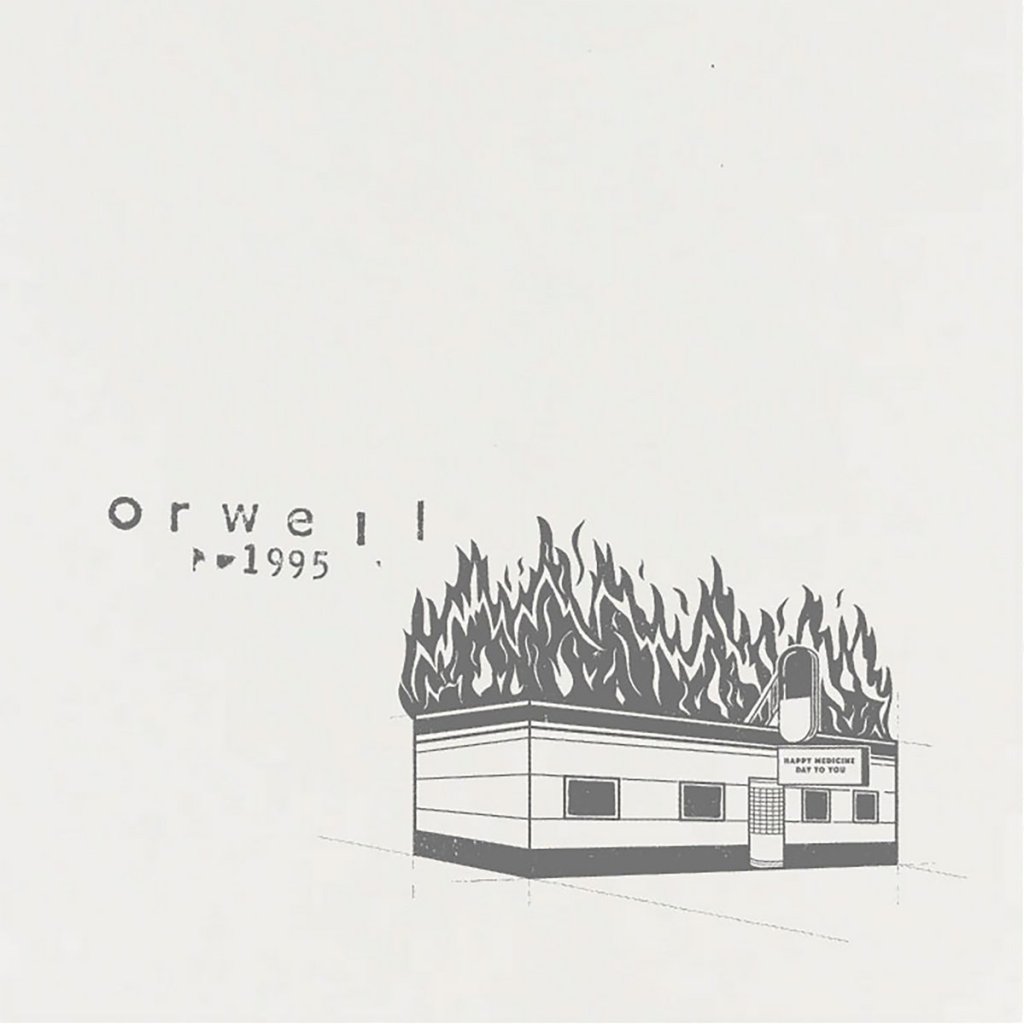
In the tradition of dusting off relics and discovering their gold-lined edges, the reissue of Orwell’s 1995 arrives as a heartbeating artifact. Their complete recorded discography has been pressed into glimmering pearl-colored vinyl, wrapped in custom letterpressed jackets, and released into a world arguably more ready for it than the one it was made in. Orwell were not one of the better-known bands of their era. They were, in fact, the type of group that often slips into the mist of regional mythology, spoken about in half-remembered stories, their flyers dog-eared and sun-faded, their names surfacing in the liner notes of other bands who “made it.” But 1995 proves they were not only worthy of remembering but of celebrating like any other Midwest emo band of that era. This album is a rare gift, a full panorama of a sound being born. Orwell sat at the convergence of emo, Midwest emo, and post-hardcore. They did not walk the genre’s paths, they forged them from the start. Their songs are messy and melodic, intricate and loud, smart without arrogance, emotional without cliché. 1995 captures the chaotic yearning of youth, but it does so with restraint and elegance.
The opening track, “4242,” originally released on the Emo Schmeemo compilation, launches the album with quivering energy. The guitars are powerful yet spacious, making room for the vocals to rise as questions shouted into an empty street. It is both uncertain and self-assured, a sonic paradox that defines the best emo. “Angular Momentum,” first heard on a Polyvinyl compilation, is a track that shows that Orwell were already years ahead. This song moves like a philosophical conversation, the guitars turn and spin like gears, the rhythm shifts unpredictably, and the vocals don’t plead, they reckon. It belongs to the great canon of emo songs that attempt to describe emotional and physical motion. Then comes “Ph9 Green,” an unreleased track from 1995, with additional vocals recorded in 2020. This is where time folds in on itself. The track bridges decades, a conversation between past and present selves. It does not feel disjointed. Instead, it amplifies the theme of the album, we are always becoming, always unfinished. The band, though long disbanded, remains alive in these notes. “Bandsaw Architecture” brings edge and architecture to the record, fitting, given its title. Originally released on the Ground Rule Double compilation, it feels like a math equation scrawled in guitar tones. There is an angular tension here, a pulse that doesn’t settle. One thinks of Drive Like Jehu, of early Braid, of Fugazi’s quieter nightmares. Orwell do not imitate others, they echo the influences while staying themselves all the time. The unreleased gems, “Icemaker,” “Chicago Skier,” “9:30,” and “Model Trains,” are where 1995 fully becomes a treasure trove. These are not cast-offs or curios. They are foundational. “Chicago Skier” might be the most poignant track on the album. Its title is playful, but the music is solemn and soaring. There’s a quiet desperation in its structure, like watching snowfall from a window and wondering where everyone went. “Model Trains” closes the album, and it does so like a whisper behind a slammed door. Soft, mysterious, and unforgettable.
The production, lovingly revisited in 2020, is handled with so much care. Tom Zaluckyj’s original recordings maintain their analog warmth, and Frank Gilbert’s remixing lets the songs breathe. Carl Saff’s mastering ensures that the sonic detail remains crisp but not sterile, resulting in a record that feels immediate despite its age. It does not pander to lo-fi nostalgia. It offers clarity, integrity, and honesty. What Orwell captured in these songs is a moment, the confusion, ambition, and vulnerability of being twenty and creating something just to see if it will stand. That moment became eternal in 1995. And while their members would go on to play in bands that reached larger audiences, Braid, Gila Band, Hey Mercedes, Haymarket Riot, Friction, the purity of Orwell is unmatched. This was a band unaware of where they were headed, and that’s what made them brilliant. The packaging of the 30th Anniversary Edition is as respectful as the music itself. The booklet, filled with photos, flyers, and handwritten memories, adds human warmth. These weren’t ghosts. They were five musicians in a basement in Chicago, fighting the malaise of the mid-’90s with guitars and ink. The vinyl itself, pressed by Smashed Plastic in Chicago and wrapped by Hammer Press in Kansas City, is a tactile homage to the handmade ethos of DIY culture. The entire collection alongside packaging looks like a piece of art. 1995 is not only a gift to longtime fans, but a crucial introduction for new listeners. Emo has evolved over the decades, its sonics have changed, its popularity has waxed and waned. But the essence remains, raw feeling, melodic intricacy, lyrical honesty. Orwell had it all in 1995 and we are lucky to have it now. Orwell have not simply restored a lost album. They’ve allowed it to be what it always was, a brilliant, overlooked cornerstone of the Midwest sound. The record is patient but passionate, full of cracked voices and harsh guitars, rhythms that stutter and swell, and words that carry weight. There is anger here, yes, but there is more wonder. More tenderness. Orwell may have only lasted a brief moment, but in that moment, they made something that still matters. And that is the art of timelessness. Head to Expert Work Records or American Handstand for more information about ordering this masterpiece.
 Thoughts Words Action