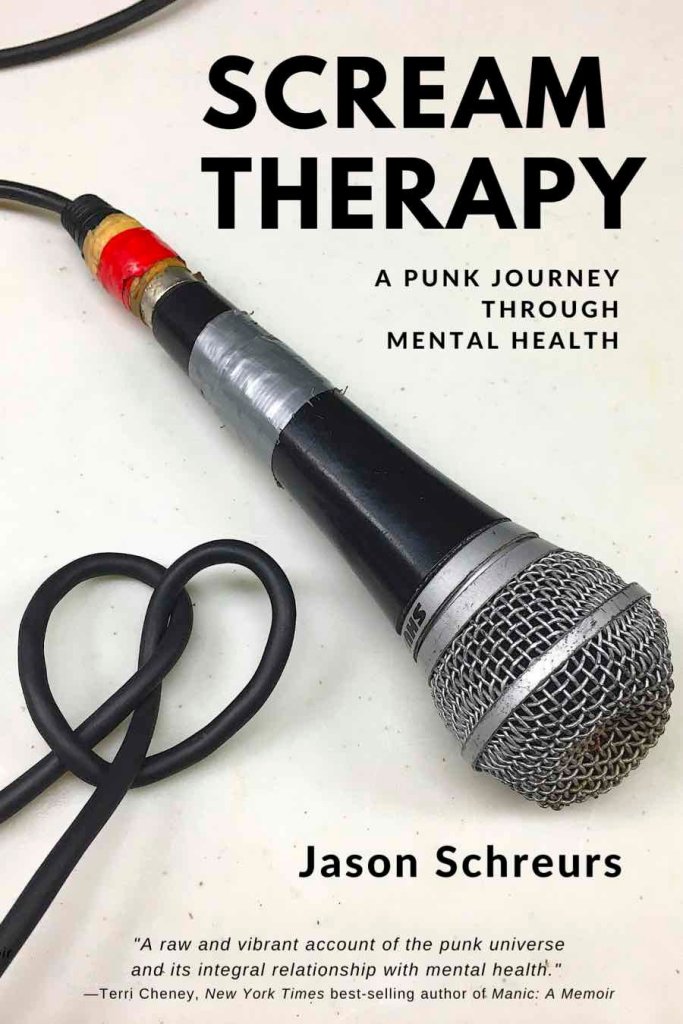
Jason Schreurs’ Scream Therapy: A Punk Journey through Mental Health is more than just a book. It’s a manifesto and a cry in the dark that echoes through mosh pits, bedroom speakers, and late-night thoughts. In this remarkable book, Schreurs turns noise into narrative, pain into power, and punk rock into healing. On the surface, Scream Therapy is a book about punk. But at its heart, it is about survival. It is about finding light in distortion. It is about the desperate need for community in a world that too often fails to listen. And most of all, it is about Schreurs himself, a man diagnosed with bipolar disorder later in life, who returns to his roots in the punk scene not for nostalgia, but for salvation. Schreurs’ writing is deceptively simple. He speaks clearly. Honestly. Without pretense. Yet, every sentence hums with emotion. He writes like someone who’s lived through the storm and finally dares to name it. He uses his years of experience as a journalist to ask the hard questions and to listen, truly listen, to the voices of others who found their truth in the scream.
There’s brilliance in the structure of this book. Schreurs interweaves his journey with the stories of other punks. These are people who live on the margins. People who battle addiction, trauma, poverty, and mental illness. And yet, they find comfort in the chaos of punk rock. They find clarity in the noise. The result is a collage of survival. A living, breathing community is etched onto the page. Schreurs does not romanticize suffering. He does not glamorize punk. What he offers instead is something much more important, understanding. He shows us that punk rock is not just rebellion. It is a refuge. It is where those who are cast aside can scream without judgment. Where those with invisible pain can feel seen. There is an immediacy to the prose. Short sentences. Clear rhythms. Every paragraph feels like a punk anthem, tight, raw, and charged with emotion. Schreurs never talks down to the reader. He invites us in. He trusts us. And in doing so, he creates a rare intimacy. One of the book’s greatest strengths is how it bridges two worlds often kept apart, mental health and music. Schreurs speaks to psychiatrists and counselors, many of them punk themselves, who are pushing against the rigidity of the mental health system. They offer alternative approaches. They speak of empathy over diagnosis. Listening over labeling. These sections feel revolutionary. They are thoughtful, deeply researched, and rooted in lived experience. However, personal stories hit hardest. Schreurs is at his most powerful when he writes about his own life, abuse, the years of confusion, the breakdowns, and breakthroughs. He does not hide. He does not flinch. He tells us exactly what it feels like to lose yourself, and exactly what it takes to come back. There is a heartbreaking moment when Schreurs recalls the moment of his bipolar diagnosis. It came late in life. It shook him. But rather than retreat, he began the hard work of rebuilding. This book is the result of that journey. It is a book built not from theory, but from survival.
The title, Scream Therapy, is perfect. Because this book is not quiet. It does not whisper its truths. It screams them. And in doing so, it reminds us that screaming is not always rage, it can be released. It can be joy. It can be the only language left when all others fail. Schreurs also deserves praise for how inclusive his narrative is. He gives voice to people who are rarely heard in books about mental health, people without access to care, people in recovery, people who’ve been failed by every system they turned to. And yet, they survive. They scream. They play. And they create something beautiful out of the wreckage. The punk scene, as Schreurs shows, is not just music. It is a network of support. It is a sanctuary for the weird, the wounded, the ones who never felt at home anywhere else. In this book, that scene becomes a metaphor for something bigger, the human need to connect, to be heard, to be understood.In the end, Scream Therapy is not just about punk rock. It’s not just about mental health. It is about what happens when the two collide. It’s about finding your voice in the feedback. It’s about turning pain into purpose. It’s about believing that even the most broken among us can heal. Jason Schreurs has written something brave. Something vital. Something that deserves to be read not just by punks, but by anyone who has ever felt alone. This book reminds us that there is no wrong way to heal. Sometimes the answer is not silence, but volume. Not retreat, but rebellion. Not shame, but scream. Head to Earth Island Books for more information about ordering.
 Thoughts Words Action