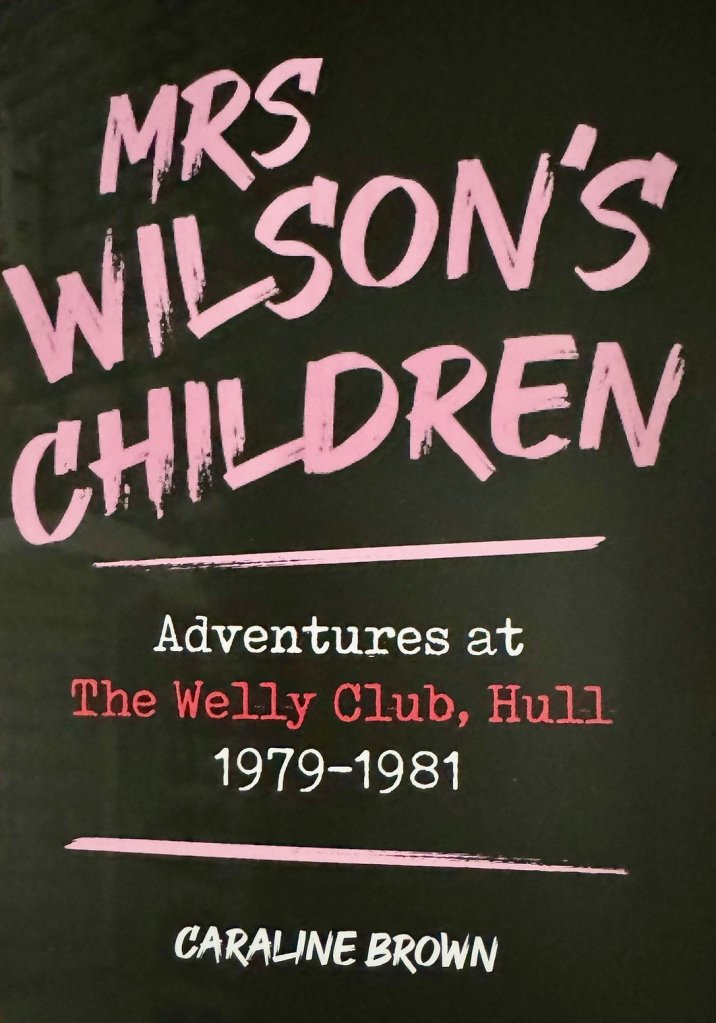
Caraline Brown’s memoir about her time as promoter at Hull’s legendary Welly Club doesn’t just list the events of the late ’70s and early ’80s post-punk scene. It puts you right there, pint in hand, as the first chord shakes the floor. The Welly Club was never just a venue. Since its founding in 1913, it’s been a kind of gravitational centre for Hull’s music scene, a place where careers could quietly begin or violently combust in front of a few dozen or a few hundred people. Roland Gift, The Housemartins, The Beautiful South, Everything But The Girl, all found their early stages here. But Brown’s tenure as a promoter, from 1979 to 1981, coincided with a moment when post-punk was still raw, volatile, and hungry, when the lines between local legends and future chart-botherers blurred nightly.
The book feels like a notebook written right in the middle of the action. Brown’s stories about booking bands like The Teardrop Explodes, The Psychedelic Furs, UK Subs, The Specials, Magazine, Girlschool, The Fall, Revillos, and many more aren’t polished legends. They have the realness of someone too busy moving equipment, sorting out set times, or handling last-minute problems to worry about making history. That’s what makes the book special, it treats the era as something real and lived, full of surprises, excitement, and the occasional absurd moment. Brown is quick to acknowledge that some stories are as apocryphal as they are entertaining. Take, for example, the infamous U2 non-gig, a show that never happened but still managed to accrue its own mythology, complete with conflicting eyewitness accounts. One recalls Bono playing on the second floor while a darts match carried on downstairs, another insists that when U2 did play, they were heckled off in favour of Echo & The Bunnymen. Neither is true, and both are perfect. This blend of fact and folklore gives Mrs Wilson’s Children the same texture as the scene it documents. Post-punk was never just about the records, it was about the stories, the impossible nights, the misremembered details retold in pubs for decades. Brown captures that atmosphere not by trying to straighten the record, but by celebrating its crookedness.
The book is also rich visually. Brown fills it with photos, keepsakes, and booking notes, many of them rough around the edges or quickly jotted down. They’re real working documents, full of the energy of the moment. You can spot pencilled line-ups, a “maybe” next to a band’s name, and doodles in the margins. It’s a hands-on reminder that even the most important gigs started with phone calls, scraps of paper, and a promoter hoping people would turn up is as sharp and unpretentious as the bands she booked. She resists the temptation to impose hindsight or inflate her role in the scene’s mythology. Instead, she writes as a participant-observer, fully aware that what made the Welly Club so vital wasn’t any one person, but the alchemy between bands, audience, and the unpredictable energy of the night. Her tone is conversational without ever becoming careless, giving the book the feeling of a story told across a table at closing time, vivid, generous, occasionally mischievous. Another thing that stands out is the picture of strength and resourcefulness. This was a time before email, social media, or Ticketmaster. Success depended on a feeling, word-of-mouth, and a lot of hard work. Brown managed line-ups, handled fees, dealt with big personalities, and somehow made it all come together. And when things didn’t go as planned, she turned those moments into stories worth sharing years later. The book’s title, Mrs Wilson’s Children, is a nod to the Welly Club’s official name, The Wellington Club, and the unruly brood of musicians, fans, and misfits who populated it. Brown’s affection for this ragtag family is notable on every page. She doesn’t write as a detached chronicler of a bygone era, but as someone who still feels the aftershock of those nights.
For readers outside Hull or unfamiliar with the specifics of the UK’s post-punk geography, the book remains utterly engaging because Brown captures something universal about live music culture. Whether it’s Hull in 1980 or any small city today, the mechanics of a scene, the tiny venues, the rotating cast of semi-famous and soon-to-be-forgotten acts, the balance between chaos and magic, remain the same. Her ability to make those nights feel immediate, even to someone who wasn’t born yet, exemplifies her storytelling skills. Brown’s wider career is impressive, too. Before this memoir, she had already shown her creativity and drive by starting the UK’s first PR company for internet businesses and winning more than sixty industry awards. You can see that same entrepreneurial spirit in this book, not as self-promotion, but in the practical skills that helped her bring bands like The Specials or Magazine to Hull at their peak. In the end, this book is a love letter to the possibility that something extraordinary can happen anywhere, given the right combination of timing, conviction, and noise. Brown doesn’t romanticise the work, she acknowledges the missed opportunities, the no-shows, the half-empty rooms, but she makes it clear that every moment was worth it. Like the best live sets, the book leaves you buzzing, nostalgic not just for the era it describes, but for every formative night you’ve ever spent in a small venue, watching something take shape in real time. Brown has written a reminder that music history doesn’t just happen in London or New York, and that the stories worth telling often begin in places the rest of the world overlooks. If you’ve ever loved a band before they were “big,” if you’ve ever stood in a room that felt like the centre of the universe for ninety minutes, or if you simply want to understand how post-punk’s restless energy rippled through every corner of the UK, Mrs Wilson’s Children is essential reading. Caraline Brown was there, she remembers, and she writes it the way it happened, loud, chaotic, and absolutely alive. Head to Earth Island Books for more information about ordering.
 Thoughts Words Action