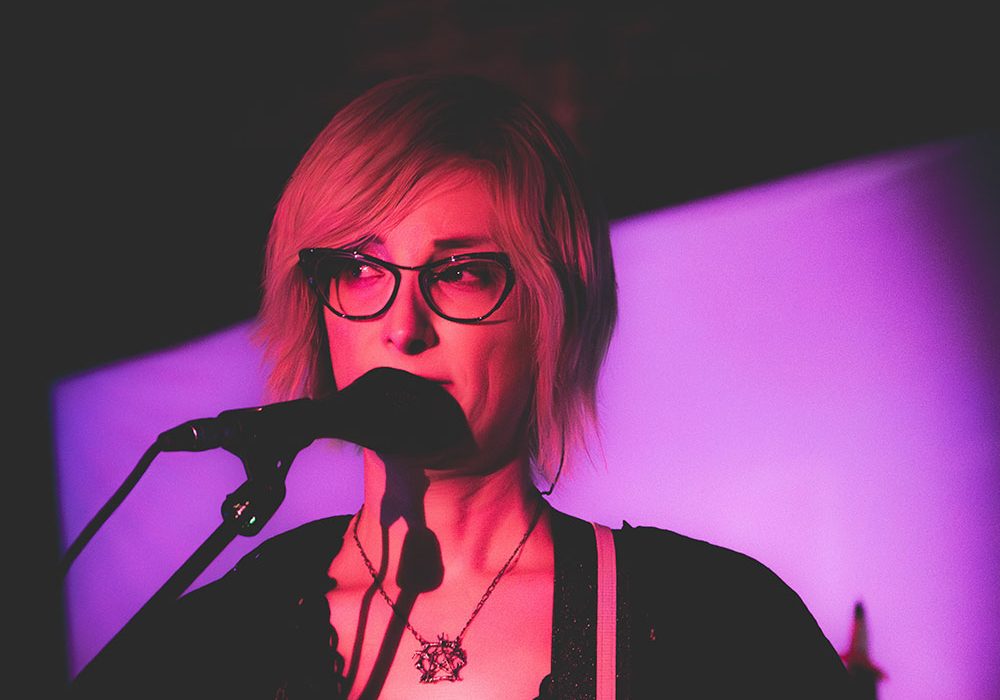

Thoughts Words Action is thrilled to welcome Portland-based shoegaze band Kallai to our pages today. We had the pleasure of speaking with Cate from the band about their captivating debut We Are Forever, as well as the mesmerizing singles “Falling” and “The Wave.” In our conversation, Cate opened up about Kallai’s songwriting and composing process, the themes behind their lyrics, and the distinctive sound that defines their music. We also discussed the band’s creative evolution and what the future holds for this promising act in the shoegaze music scene.
Hello, thank you for taking the time to answer these questions. How have you been?
*Deep Breath and a laugh* You know, there was a time when that would be a pretty straightforward question to answer, but there are so many days now where I just don’t know what to say. The band and I are doing well in isolation. We just wrapped up a round of vinyl pre-release shows here in the PNW with a bunch of amazing local and touring acts that went really well. On the other hand, a few weeks ago I witnessed one of my neighbors being taken by ICE and was there as the first adult to help a 13-year old kid in the aftermath. The whiplash between these real-world horrors, the continued mundanity of day-to-day life, and the relative (albeit low-level) success we’re seeing with our music is a surreal sea to be swimming around in right now.
Your debut album, “We Are Forever,” is about to be released on October 17. What does it feel like to finally share this body of work with the world?
I have a profound sense of relief that it will actually be seeing the light of day! I’m a disabled mixed-race trans woman, and there’s a whole fundamentally fascist political movement in ascendance in our country that explicitly wants to eliminate people like me from public life which includes banning our art. I was joking with another trans artist earlier today that it really sucks that we all feel compelled to make ‘we have always been here, we will always be here’ statement albums right now. On the plus side, I am really happy that we have all managed to release them and that so many of them are fantastic.
The singles “The Wave” and “Falling” set a powerful tone for the record. How do those tracks represent the album as a whole, and why did you choose these particular tracks as the lead singles?
I view “The Wave” as the catharsis of the album where the protagonist of the larger story being told embraces who they are, rejects shame, and is able to begin healing from their trauma. “Falling” is to me about the hope of courageous possibility that comes after someone is able to accept and love themselves. Singles are kind of like movie trailers where you want to emphasize some of the emotional heights, so those two seemed like natural fits. Plus I just think they have some level of pop hook to them that makes it easy to grab people.

Can you walk us through your songwriting and composing process? Do songs usually begin with a lyrical idea, a chord progression, or something else?
Most of the time our songs begin with a hook or chord progression. I like to take that, and either lay down a basic drum pattern for it or find one in one of my midi libraries to start. Then I will either write or find another drum pattern to use as a possible new section. I’ll loop those together playing the first riff, and then try to come up with another progression that feels like it fits the dynamic changes. It’s basically rinse and repeat on that process until a rough demo is recorded, which I will usually share with the group. We’ll typically test it out in rehearsal and if it goes well I will take it back home and begin working on lyrics and vocal melodies. Sometimes I already have a lyric or a basic sense of what story the music is whispering to me, other times I don’t.
The record wrestles with themes of strength, identity, and political turbulence. Was writing these songs a purifying process for you, or did it sometimes feel overwhelming?
I felt a profound sense of responsibility and urgency when writing these songs. Like I mentioned before, so many artists I know are feeling like they need to write, record, or otherwise express their specific experiences with the knowledge of what has been done to our communities in historic moments similar to today. There were versions of some of the tracks that have been sitting on my computer for 5+ years, but to get vinyl pressed and distributed this year meant that all of them had to be completely re-written, rehearsed, and recorded in a ~8-10 week period. It was an incredibly intense experience and there were points where the tension spilled over into our interactions as band members.
Were there any particular tracks that were more challenging to write or record than others? What made them so difficult to work with?
“The Wave” posed some difficulty. Less about the music and recording, but more about the engineering. It was due to be the first single off of the record and we had an incredibly short amount of time to make sure it was as dialed in. The timing there triggered some of those tense band moments. On a personal level, “As Night Falls” really required me to up my vocal ability. I had already been spending a good amount of time working on extending my vocal range, and the outro demanded that all of those efforts needed to bear fruit for the song to work as intended.
Your sound sits somewhere between dream pop, post-punk, and shoegaze. How did you achieve this mixture, and what attracts you to those particular textures?
I would love to say there is a high degree of intent behind our sound, but that would feel disingenuous! I generally go into things without a particular idea if a given song is going to be more post-punk, or heavy, dream-pop, or what have you. Most of the time when I write it is with an acoustic guitar or piano, and the various textures or production choices come in later when a particular rhythm or vibe hits me. The main thing I try to do with every song is make sure there is a good amount of dynamic range and that arrangements match the stories being told. It is really easy to lose that in a sea of reverb and delay.
Is there any particular formula for how you reach familiarity and expansiveness when arranging and layering your tracks?
I don’t know about familiarity versus expansiveness but layering tracks is something that can drown a song if not done with care. On this record it really meant being intentional about what specific guitars and amps were being used for each part and understanding how their characteristics should fit together before we ever sat down to record. It also involved knowing where, say, the bass would be sitting in the frequency spectrum—what kind of tones Brian likes to use—and recording the guitars in a way that made room for that without needing a ton of EQ adjustments during mixing even though some of the songs are played down in something low like Drop-A tuning.

You recorded at both Revolver Studios with Collin Hegna and your own Synthetikit Studio. What was that process like, and how did the two environments influence the final sound?
So our eponymous EP was for all intents and purposes something of a ‘punk rock basement’ recording. For “We Are Forever” we really wanted to make sure that we had a solid foundation. So we decided to track drums with Collin over at Revolver. Aside from his own band, Federale, and his work with The Brian Jonestown Massacre, he has also worked as a producer and engineer with a ton of fabulous local bands and artists like David J. So we knew from the start that we would be in really good hands. I was in the studio for the session with him and Daniel and it was both a welcoming and efficient experience. The engineering work Collin did on the recording side made our mixing sessions at Synthetikit incredibly smooth.
Tracking vocals in particular can be a very vulnerable experience, so having Synthetikit available as a space to do that allows for an experience where you know going in that you’re going to be taken care of. I don’t think I could have done all of that work in as tight of a time frame as we had with a space that didn’t already feel like home.
“We Are Forever” arrives in the time of political and personal upheaval. How do those lived experiences shape the lyrical and the emotional delivery?
The album as whole is largely an expression or extension of my lived experiences. Like the characters in the songs, I grew up in abusive environments and have had to find a way to live while carrying the ensuing trauma with me. I have been witnessing my rights and humanity being under attack and felt rage. And I’ve found love, art, and community that has bolstered my resolve.
As far as emotional delivery, I would point to “As Night Falls.” The vocals in the last few bars of the outro were never in the original demo. I had had a very difficult day following the onslaught of executive orders coming out early in the year and I basically improvised that part live during rehearsal. I had never really sung notes that high as part of the band and when we wrapped up the guys were a bit shocked at that. I like to think the shock was a good kind since they keep letting me sing it.
The album also carries a sense of defiance and endurance. How did you land on that phrase, and what does it mean to you as a band?
“We Are Forever” is a line from an episode of Buffy: The Vampire Slayer. It’s in an episode where the gang is facing a seemingly impervious monster constructed by a shadowy part of the US government, and they channel primeval magics to join all of their individual strengths together to defeat him. Ultimately the villain—and the structure that created him—fails because they think they can impose their will and order on forces and people that are beyond their understanding.
In a similar sense, I feel like the entire fascist project that is coming for our communities right now can never fully succeed. People like us have always existed, have always found community, have always lifted each other up and survived. It is something primeval. The people who want us gone will never be able to actually contain and control natural human variation.
For me then, the phrase and album title are all about how community, art, and found family are going to be what gets us through the darkest of times.
Your music feels rooted in the present, but also resonates with timeless, almost mythic moments. Do you intentionally incorporate that duality into your writing?
It was definitely an intentional element of this record, and I wouldn’t be surprised if it continues on future releases if we are lucky enough to make them. The band takes it’s name from “Wrath Goddess Sing” a trans retelling of the Iliad so thing mythic and queer are baked into whatever we do. I don’t sit in a social position where I can afford to be unaware of what is going on, so the present is always weighing on me as well. I don’t know if that flows into the instrumentation or the production of our music, but it absolutely does with respect to the lyrical and emotional context.
As a debut album, what do you hope listeners take away from “We Are Forever?”
I hope that people who have similar life experiences to mine feel seen. I hope that they can take strength from knowing they are not alone. I hope they come away knowing that we can and will get through things together, because we always have: literally we are forever.
I know those life experiences aren’t shared by the vast majority of our current audience. I hope they like the music enough to shell out some cash and get the second half of our vinyl run out of my spare bedroom.
What are your plans following the release? Will you be touring, releasing more singles, or perhaps experimenting with new material already?
We will be doing a West Coast Tour in the spring, and might have a small follow-up EP of some kind out between now and then. I am not one to try to force the writing process, so that release might be a new single plus a cover, some live tracks, or remixes.
Looking ahead, where do you see your sound evolving after this album? Do you envision pushing further into shoegaze textures, post-punk territory, or exploring new sonic directions?
Every time I set out to write a song of a particular song or genre it always ends up somewhere I didn’t expect. That said, things I am listening to always seem to bubble over into whatever it is I am working on at the moment. If I had to guess I would say that more of the heavy grunge inflected shoegaze stuff will be there, but also maybe some trip-hop elements here or there.
That’s it. Thank you for your time. Anything you would like to say to our readers at the end of this interview?
Be kind. To yourself. To others.
 Thoughts Words Action