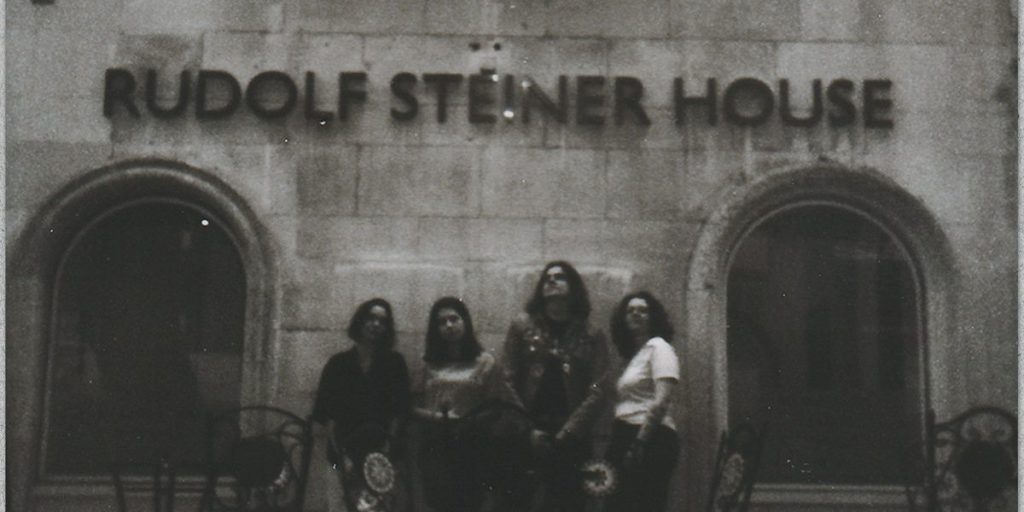

Kisu Min’s Rudolf Steiner House belongs in a category of one of the finest indie recordings in recent years. It is not a polite entry into the crowded field of indie rock, nor a retreat into solipsistic bedroom pop. It is a conscious, ambitious work that recognizes the haste of the times and attempts, through sound, to wrestle with questions of division, healing, and humanity. Many indie records gridlock in irony or retreat into private melancholy, while Kisu Min does the opposite; they step out into the world and confront it head-on. This band has always carried a sharp edge beneath their melodic sensibilities. Their 2023 release City of the Revolution hinted at the capacity of their vision, fusing angular guitar work with politically attuned lyricism, but Rudolf Steiner House takes that energy further, less concerned with documenting social fractures than with imagining how to live through them, and perhaps even past them. The choice of Steiner as a touchstone is not incidental. In traveling to London’s Rudolf Steiner House for inspiration, Kisu Min sought not just a symbolic refuge but a framework, Steiner’s lifelong project of reshaping education as a holistic, humane endeavor. They do not attempt to sermonize or flatten these ideas into slogans, but absorb them and allow their music to translate that search for wholeness into texture, rhythm, and melody, resulting in a wisely assembled record that will immediately grab your attention.
Sonically, Rudolf Steiner House is their most expansive and confident work to date. It flourishes on the interplay between control and liberation. Ciupińska’s vocals carry the dual burden of vulnerability and command, airy and spectral, cutting through the mix with a subtle defiance. There’s an undeniable sincerity in her delivery that sidesteps the theatricality often afflicting politically engaged music. She does not declaim from above but inhabits the songs as one of us, grasping for clarity in a time of overwhelming noise. Sobańska and Ciupińska’s guitar works build expansive landscapes. They fully stacked this album with post-punk angularity, shoegaze haze, and synth-driven shimmer, but always tempered by precision. Each guitar line feels intentional, whether rough or fluid. Szafarz’s basslines are co-narrate this story, with its melodic figures often pulling the songs into unexpected emotional registers. Pyziak’s drumming is lean and exacting, rarely flashy but always driving the songs forward with tasteful pace. The shifts in tempo, sudden breaks, and polyrhythmic flourishes speak of a band confident in its ability to disrupt without disorienting. Synths play a crucial role in shaping such an otherworldly atmosphere. They saturate the songs with an ambient glow, warm, icy, but hinting at the tension between hope and fracture. The record aligns itself with the best traditions of European synth rock, not escapist but elemental, less about flights of fantasy than about reframing the real.
These songs mirror the very questions the band claims to be wrestling with, how do we educate ourselves to endure? How do we resist division without succumbing to despair? What does healing even look like in the context of systemic breakdown? These are not questions answered in words alone, they are worked out in the tensions between guitar lines, in the interplay of synth textures and percussion, in the way voices overlap and diverge. There is an undeniable political charge here, but it is never didactic. The band refuses easy moralizing or slogans. Instead, the politics are lived, felt through the contours of sound, in the dissonance that gives way to harmony, in the blasts of chaos that resolve into fragile beauty. Listeners can hear the band grappling not with ideology but with lived contradictions, with the texture of daily existence in a fractured world. Antena Krzyku, the label behind this release, deserves praise for championing music that refuses to dilute itself for commercial palatability. Rudolf Steiner House is not an algorithm-friendly record. Its structures resist easy playlisting, its mood shifts are too complex for background listening. This is a work that demands engagement, that insists you meet it on its own terms. In doing so, it offers a vision of indie rock not as a lifestyle accessory but as cultural critique, as aesthetic resistance.
What remains most after listening is the sense of conviction. Not the conviction of certainty, Kisu Min do not claim to have the answers, but the conviction that music must dare to engage, question, imagine otherwise. In a cultural climate saturated with detachment, the willingness to believe in the possibility of change, even in the smallest gestures, feels radical. Rudolf Steiner House is not an easy record, but it is a vital one. It captures a band at a moment of growth, pushing themselves beyond the familiar comforts of indie rock toward something more volatile, more necessary. For listeners weary of irony and detachment, Kisu Min offers music that confronts division, embraces fragility, and insists on humanity. Rudolf Steiner House is a sonic intervention, a call to listen differently, think differently, and live differently, and in that sense, it fulfills the very ambition embedded in its title, not to preach from a pulpit, but to build a house where we might begin again.

 Thoughts Words Action