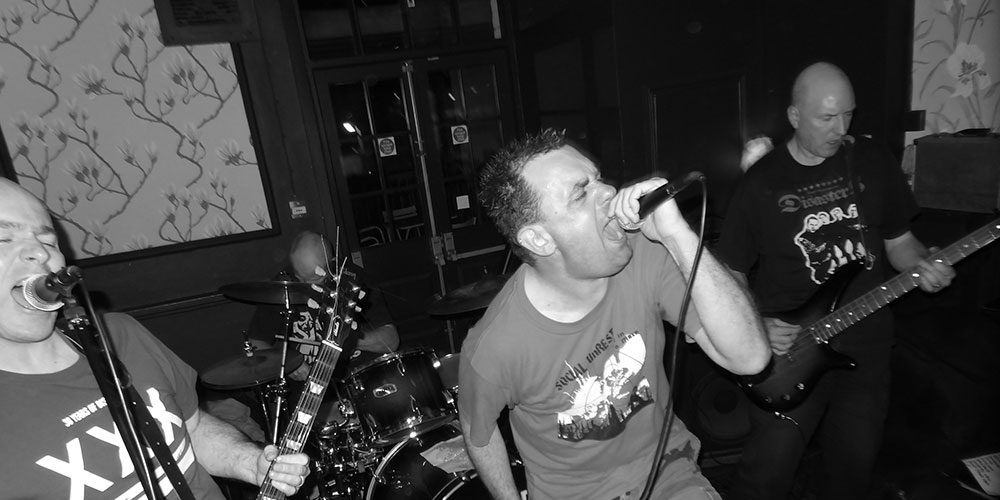
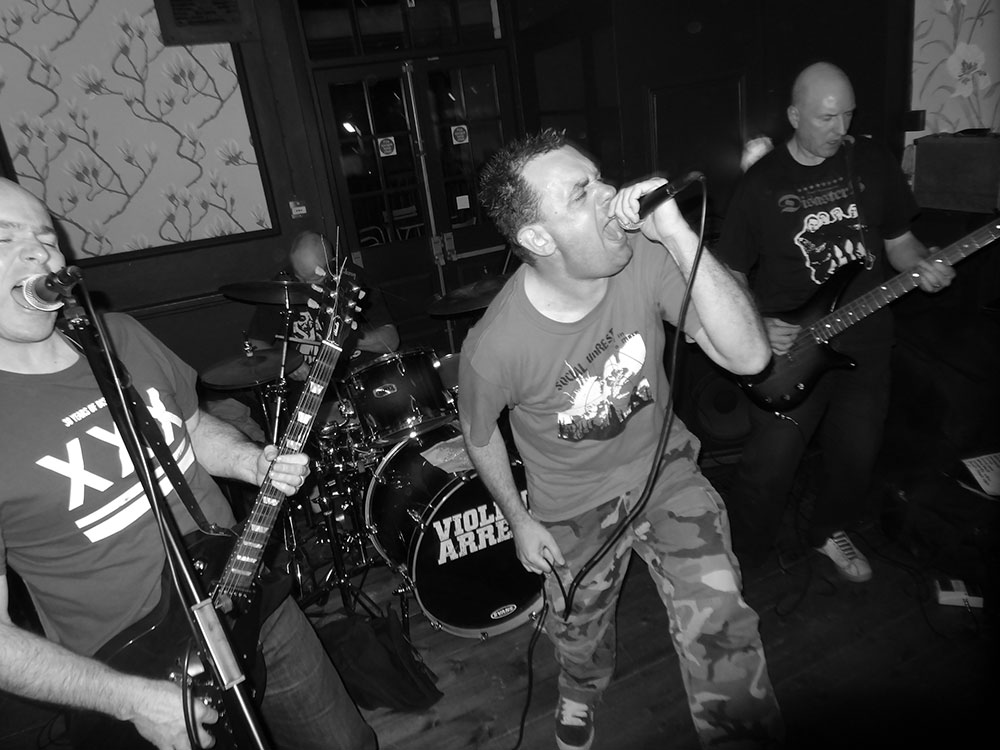
We’re thrilled to present to you an interview with Welly Artcore. Welly is the author of two seminal books, ‘Directions to the Outskirts of Town: Punk Rock Tour Diaries from Nineties North America’ and ‘Nefarious Artists: The Evolution and Art of the Punk Rock, Post-Punk, New Wave, Hardcore Punk, and Alternative Rock Compilation Record 1976–1989.’ He’s also runs longstanding Artcore Zine. We spoke about his books, the punk rock scene, graphic design, etc. Enjoy!
Your journey in the punk rock scene started in the late ’70s in Cardiff, Wales. Can you share some pivotal moments that fueled your lifelong obsession with punk rock and led you to start creating your own fanzine, Artcore, in 1985?
Welly: I was a little too young to catch 1977 punk as my tenth birthday was in October 1978, so the real start for me was from then into 1979 when I’d tape the UK Top 40 off the radio, and I first started taking notice of stuff like The Dickies, The Clash, The Police, the end of Sex Pistols, and others. I’d have to get permission though, and punk or new wave was frowned upon, so “no” was usually the answer. The local shop would sell ex-jukebox 7″s in a box next to the daily newspapers, so I’d buy records there. That was my start, then 2-Tone hit in like the autumn of 1979, and that was more palatable for the parental board of censors, so I got fully into that. I started high school in 1980 while 2-Tone was in full swing. By 1982, my friends into the rude boy stuff were getting into Oi! I could see the writing on the wall with that, and at the same time, a girl in school gave me a copy of “Setting Sons” by The Jam she didn’t want, and I became obsessed with them even though they split up at the end of the year.
One day in 1983, I asked an older friend to ask his older brother if he had anything “more powerful, more political,” and he came back with the first albums by Dead Kennedys and Stiff Little Fingers. I was blown away by both, but Dead Kennedys completely changed everything for me. I became obsessed with them and bought everything, and then I found a Dead Kennedys book with a discography in the back, and it had compilations they were on. I sought out these compilations and found albums like “Let Them Eat Jellybeans.” From here, I discovered this thing called “hardcore,” and it just took over my life. I became obsessed with finding music by bands like DOA, Black Flag, and Circle Jerks, and I jumped right into it, never to return.
Throughout 1984, through buying all the other releases on Alternative Tentacles I could find, I discovered labels like Dischord and Better Youth Organisation and bought their compilations, and it all snowballed from there. I didn’t know anyone else into this stuff, and by 1985, I finally got the courage to ask to look at a copy of Maximum Rock’n’Roll from high on the wall at my local record shop. Up until then, I’d thought it was a political mag and that it was inaccessible in the shop, but when it fell open on the counter to a DK advertisement, I bought it. Back home with this MRR, I read the then-new “Between the Lions” zine listings in the back and had an epiphany as I connected punk music with the little illustrated books I’d been making since I was a kid. I used my Christmas cash in 1985 to send off some stuff from the bands in that issue of MRR, and I began work on my first issue during the school holidays, which came out in January 1986 and was copied on the Xerox machine in the high school office. It was from there that I started to hear from and meet other people who were into “hardcore”, both locally and from the U.S.
As a graphic designer, you’ve contributed to over 170 published releases for punk bands and labels. How has your graphic design background influenced your approach to creating album covers, and are there any particular releases that hold a special place in your heart?
Welly: I think it’s nearly 190 now; I’ve been keeping count, ha ha. Well, my graphic design “background” is punk rock; that’s how I started out, and that’s where I remain. I started making “punk art” in art class in school and later at home with the zine, and very soon I was sending to other zines and doing stuff for my friends and local band The Heretics in 1986. From there, we met Karl of Words of Warning Records in nearby Newport, and I did my first record covers for him in 1987. When I found out what I was doing was called “graphic design,” I managed to get into college after a few attempts and studied it for four years between 1987 and 1991 at print school and art college, although admittedly my main motivation was to use the equipment to make zines and punk art. I’ve never had a 9-5 job as a designer; I just do my own thing, and hopefully that was a blessing in disguise as I didn’t just end up doing work for someone else.
Releases that stand out are my first covers for Words of Warning, like the Cowboy Killers first LP, and then bands I got to work with through the years doing stuff for Boss Tuneage, such as old favourites Moving Targets, but a high point was definitely getting the chance to do the Coventry Automatics LP sleeve, AKA The Specials, as that was a band that had started it all for me back in 1979. It was also great to work on th’Inbred reissues for Alternative Tentacles, again because that label was where it all started, and I’d been in touch with th’Inbred since the late 80s and somehow got it all released. It was originally supposed to be on Grand Theft Audio, but they folded, so I contacted A.T. and got a reply from Biafra saying they were into it. It turned out the band was originally going to sign to A.T. in the 80s, but it never happened, so it went full circle. That was great.
Artcore Fanzine has been an enduring project, with 42 issues and 20 vinyl fanzine releases to date. How has the fanzine evolved over the years, and what has kept you motivated to continue publishing it for so long?
Welly: The drive is to promote bands I like and keep improving, I guess. It’s evolved into half the zine being historical with the “Vaultage” section, and a lot of the records that I ended up releasing with it as a result are documentation of older music. I find that interesting to work on, writing about old bands and then presenting it all graphically as best I can. I believe that in punk rock, we need to document our own history, or other people who weren’t involved will do it for us badly. Especially now in the age of the internet, where everybody knows about this stuff, or at least thinks they do. What we do isn’t a secret anymore; it’s everywhere.
Like I said, with each issue, I try to improve the graphic design and try new ideas rather than just copy whatever design style is in fashion. I try to convey the energy and urgency of the music through the page layouts. A driving factor is also to promote the underdog. I do loads of interviews with bigger punk names, but it’s always been about the lesser-known bands who don’t get any support, especially UK bands, as they are pretty much ignored these days. I just want to use the zine to hopefully help bands and people who make stuff that I find interesting. I think it’s now more important than ever as it’s so much easier to get lost in the ocean of internet music that’s out there that’s full of unwarranted hype and flash-in-the pan trends.
In addition to your work with Artcore, you co-founded Four Letter Word in 1991 and played the role of vocalist. How did your experiences in the band shape your perspective on the punk rock community, and what lessons did you take away from your time with Four Letter Word?
Welly: I did that for twenty years, and I guess I learned a lot about people. We did a lot of touring, which was great as we saw some of the world for next to nothing. Writing and recording was the part that I probably enjoyed the most, and we recorded all four of our albums with Frankie Stubbs of Leatherface and got to know him well, so that was good. We did two albums on the legendary BYO Records, which was run by the Stern brothers of Youth Brigade. That was a favourite label of mine growing up, and I never thought that would happen. Through them, we got to play all sorts of crazy gigs and tour the US and Canada.
I also handled pretty much everything band-wise, from getting those records on the labels to booking tours, vans, practice, making merchandise, etc. It’s just my nature to do that, but sometimes it felt like some didn’t always appreciate all that work and took those things for granted, especially when you hear about them having nothing good to say about you or the band years later. I wasn’t an angel, but neither were they. Like I said, I guess I learned a lot about people.
Being in a band wasn’t always easy, but it was rewarding, especially writing lyrics, finding samples and quotes, and putting the whole concept together with the graphic design—the full package. I used to really enjoy doing all that and hopefully bringing something new to the punk rock table, whether it wanted anything new or not. As great as touring is, it can destroy the strongest of bands.
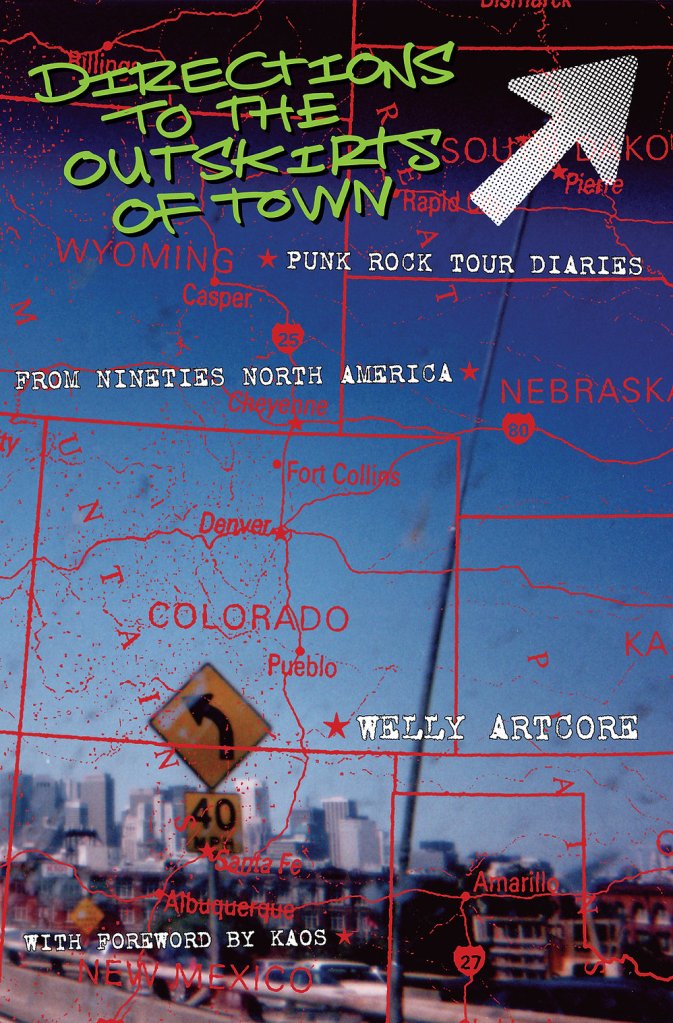
‘Directions to the Outskirts of Town: Punk Rock Tour Diaries from Nineties North America’ provides a candid and humorous account of life on the road with a touring punk band. What inspired you to document these experiences, and what do you hope readers take away from the book?
Welly: It goes back to those illustrated story books I’d make as a kid and being a zine maker. When I got the chance to go on the first tour with Chaos UK in 1994, due to my old friend Marvin being their bassist, it seemed obvious to take a journal as well as a camera, as it was a totally new experience that I didn’t want to forget. I jotted down stuff every day or so; sometimes it was difficult to do on the road, so it’d just be a few words as a prompt to remember something that happened. I draw a lot too, so there were also caricatures of all the bands we toured with, and a lot of it ended up in an issue of Artcore, where the tour report first appeared after I’d written it all up on my return to the UK.
When it came to the 1998 tour with Four Letter Word, I automatically did the same thing and printed the tour report. Years later, it occurred to me to rewrite them a little better and put them into a book. In regards to what I hope readers take away from it, I think it’s the example that anyone can do the same thing and hopefully inspire people. It’s also not a glowing report of touring life, so it’s also an attempt to dispel the myth that it’s all “sex and drugs and rock ‘n’ roll.” A lot of touring is being bored driving for 10–12 hours a day, and things can get tense between people. It was also from before the internet, when things were very different, so it’s also an attempt to highlight that fact too. We were the last generation of bands to do that—just go out there blind with a map and no internet. That’s never coming back, so I thought it was a good idea to take a look back at it now.
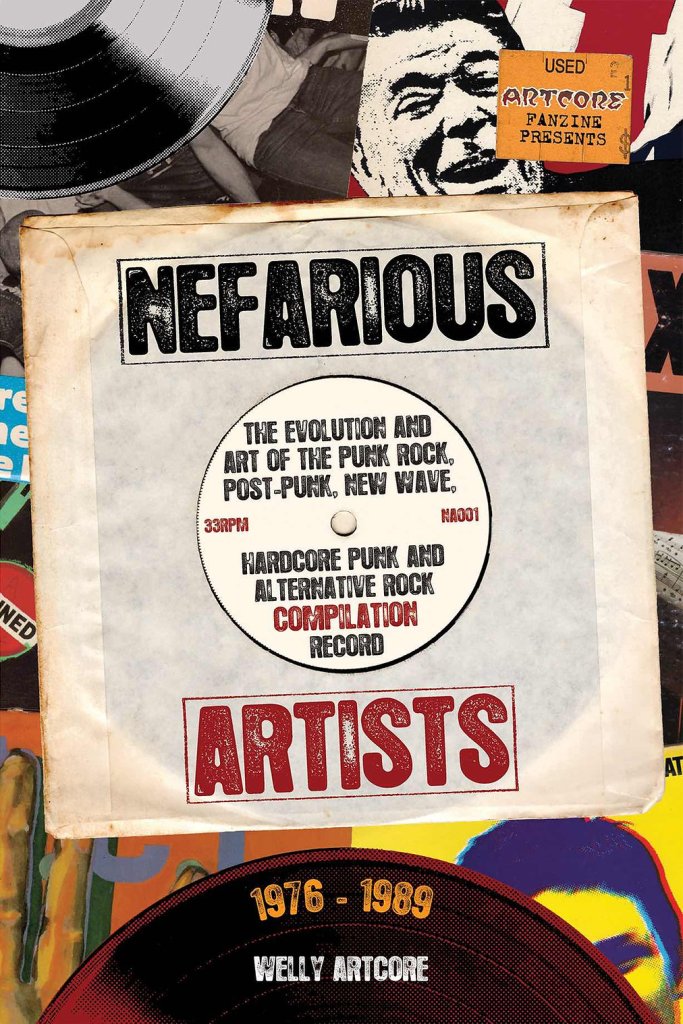
Your new book, ‘Nefarious Artists: The Evolution and Art of the Punk Rock, Post-Punk, New Wave, Hardcore Punk, and Alternative Rock Compilation Record 1976–1989,’ delves into the world of punk rock compilation albums. What motivated you to explore this specific aspect of punk rock history, and what challenges did you face in compiling such a comprehensive study?
Welly: I realised one day that I had over 600 compilations, and I was thinking about how important they were in forming my musical taste and knowledge. It then occurred to me that no one had written a book about compilations, and considering how many people were influenced by them, I thought it was odd that no one had, and it was really a no-brainer, so I started working on it immediately. Another reason was that I’d been trying to figure out for a long time whether there was a way to tell a rough story of the history of punk rock in a holistic sense without it being too long, as I think context gets lost these days with books about “1977-1982,” etc. And that means people need a certain level of knowledge, or that particular book they are reading has no context for what else is going on. That was also the inspiration behind the “world events” sections throughout the book.
I guess a challenge in writing it was that I soon realised that I needed so many more and started selling records to get the compilations I needed. This went on for over a year, and in the end, I ran out of funds, and I now have over 800 compilations. Another challenge was that I listened to them all as I wrote about them, which was like 8 hours a day, 5 plus days a week, and it did become difficult, especially in the mid-80s when there were so many to get through each year, but I pushed on and got there in the end. There are still compilations I wish were in there but aren’t, but hopefully there’ll be a second edition at some point as I’m still buying them. I can’t seem to kick the habit now.
Over the years, you’ve been involved in various punk rock endeavours, including running DIY punk rock record shops, promoting gigs, and making flyers. How have these diverse roles contributed to your understanding of the punk rock community, both in the UK and the US?
Welly: I guess I know it inside out by now, haha. For me, the whole punk rock thing was always about putting something back. You’re more than a witness or a consumer in DIY punk, so it means you have to, or should, contribute, and it just so happens that I’m the kind of person who’s always working on something, always making things, so I can’t help but get involved in all sorts of stuff. No gigs for your band? Put one on. No record shop? Open one. That’s what punk rock taught me anyway: just make things happen because no one else is going to do it for you.
It’s all about promoting the music and trying to preserve the subculture, and if we stop as participants, it goes away. Look at how much has changed since the internet and social media. It’s not really an improvement; it just promotes apathy and consumerism. Someone said to me when I had a record shop that it was “interesting” that I was running a “purely capitalist operation,” but it wasn’t about that. I never made any money doing it; it was about creating a space where people could meet, talk, and exchange ideas. And it worked because bands were formed in that space and people learned about new music they’d not heard of before. At that time, I was also putting gigs on and making flyers. You’ve got to keep busy; we’re only alive for a short time.
You’ve relocated to Arizona in 2018. How has the transition from the UK to the US influenced your perspective on the punk scene, and are there notable differences you’ve observed between the two?
Welly: Well, there doesn’t seem to be much going on here, but I’m probably out of the loop. There are some gigs worth going to, and I have made it to some. Stuff seems to be happening back in Wales since I left, so maybe it’s a good thing I did leave. Maybe it needed a clear-out of some dead wood, “making room for youth,” and all that.
‘Nefarious Artists’ covers a wide range of punk rock genres and compilation albums. Can you highlight some discoveries or insights you found particularly fascinating during your research for the book?
Welly: It was really endless. That’s what I like about music—it never ends. I found some gems in compilations and some great hidden songs. An interesting part was doing all the research and finding out stuff I didn’t know about people who ran labels or people in bands, some of whom went onto other things and are buried in the credits somewhere. Young people made obscure hardcore sleeve art and then went onto work with massive bands and labels. Just drilling down into each release and the back catalogues of labels and finding out interesting stuff, I get totally immersed in this kind of thing. Punk rock was always about so much more than the music. Especially when it went really DIY in the hardcore years, it was this massive global creative wave made by kids outside of everything that went around the world, and its ripples can still be felt today. The book just took over my life, and I enjoyed writing it and putting it together. I hope it’s a useful tool for people now and in the future.
Looking back on your extensive involvement in the punk rock scene, what advice would you give to aspiring graphic designers, musicians, and DIY enthusiasts who want to contribute to and thrive within the punk rock community?
Welly: Get involved. Punk rock is a two-way thing, a conversation, and we all have a voice and something to contribute. And if everyone does contribute, that conversation is all the better for it. Again, it’s all about the DIY. I’m just some nobody from a council estate; people like me aren’t supposed to have two books out. That’s what punk rock taught me; anything is possible; you’ve just got to get on with it. I’m not imparting any new wisdom here. Identify the goal and move towards it. “This is a chord. This is another. This is a third. Now form a band.”.
I’d also say don’t get too hung up on trends, especially if you’re playing music; just throw all your influences into one pot and not just follow one influence for one specific band or project. Music is better when it also looks forward rather than just backward, so try to create something unique rather than merely follow the crowd or simply copy past templates. It’s been a privilege to have been involved for a long time and watched it all evolve, so I’d like to think I’ve learned something and hopefully contributed something along the way. Thanks for the opportunity to take part in your conversation.
 Thoughts Words Action