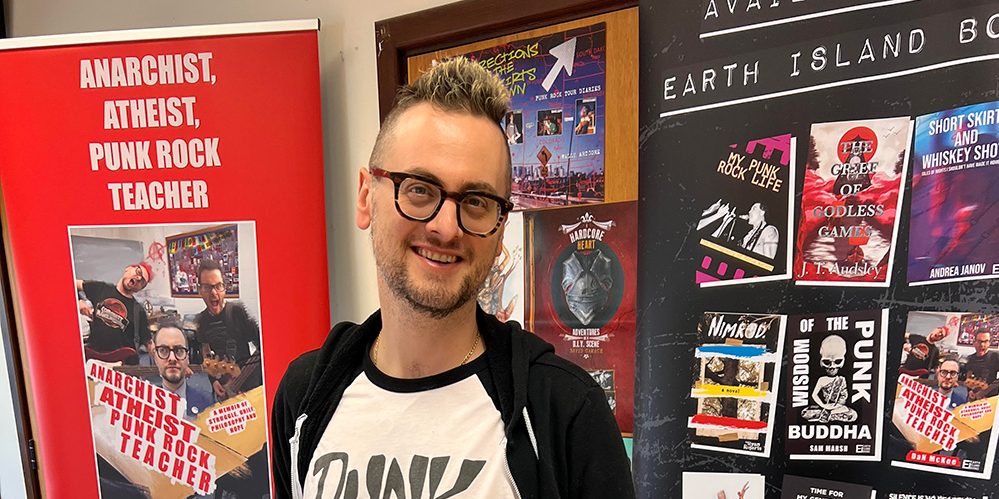
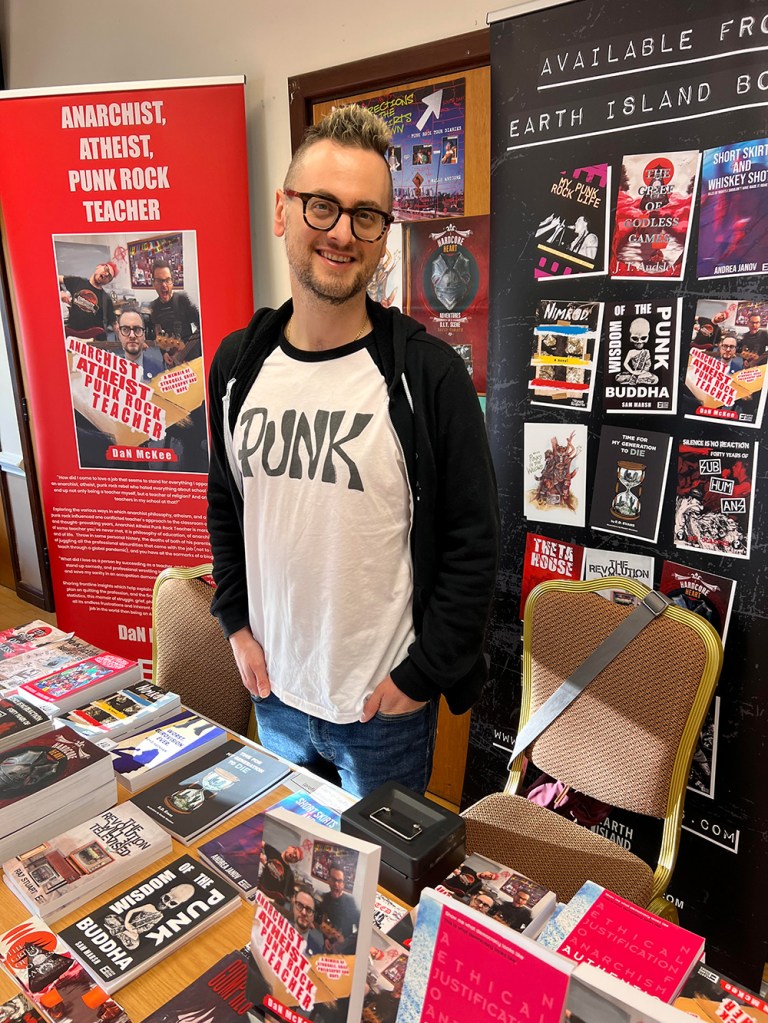
We recently spoke with Dan McKee, the brilliant mind behind the thought-provoking book, “Anarchist Atheist Punk Rock Teacher.” We had the privilege of diving into the depths of his insightful work and gaining a deeper understanding of the inspiration that fueled its creation.
To start off, can you share a brief overview of your book, “Anarchist Atheist Punk Rock Teacher,” and what inspired you to write it?
In January of 2022, after over a decade of teaching, I decided to quit my job. It was a New Year’s resolution. I woke up on the morning of January 1st and sent an email to my boss, the headteacher of my school. I had no idea what I planned on doing next, but it was far from a spur of the moment thing. The years of conflict between my personal identity as an authority-hating, god-rejecting, anarchist punk rocker who hated school as a child, and my paying the bills as an adult by being an authority-figure in that very same soul-suffocating institution, teaching religion and philosophy no less, had taken its toll.
I started writing the book in June, later that same year, reflecting back over my years in the classroom. It’s called a “memoir of struggle, grief, philosophy and hope” because those years felt like a constant struggle between who I really am, and who the profession expects you to be. It was also a period in which both my parents died, so there was that to juggle too, and I reflect a lot in the book about those other conflicted relationships in my life with my mom and dad, and the impact their deaths had on me, both as a person and as a teacher. As a philosopher, I can’t help but think a lot about the things that happen to me, so there’s a lot of that in there too. And the hope part is about how, surprisingly, by the end of the book, it turns out I go back into teaching again, somewhere new. That there is light at the end of the tunnel even if it’s just the light from another tunnel. So it’s a book about teaching, about identity, about loss, and about my thoughts and experiences within this awful and awesome, intrinsically problematic, profession.
How did your background in anarchist philosophy, atheism, and punk rock influence your approach to teaching over the twelve years explored in your memoir?
For the full answer on that you’ll have to read the book, because that’s really what it’s all about – there’s a chapter on each of those themes. But the short version is that my background in anarchist philosophy (I got my PhD writing a thesis on the ethical justification of anarchism, also the subject of my other book, Authentic Democracy) made me both resistant to go into teaching in the first place (all cops are bastards, all teachers are cops, therefore…, etc…) and also go into it with my eyes wide open about all that is wrong with it when I finally did take the plunge. It made me want to experiment – for good and for bad – with the underlying ideological trappings of the job and poke at and subvert things where I could, even if only by pointing out some of the absurdities of the system to students that are usually kept hidden from them. That instinct was helped by the influence of punk rock. The idea of “Do It Yourself” and “fuck authority” makes it a lot easier to ignore the entrenched hierarchies that exist in educational institutions and march to the beat of your own drum regardless of the possible consequences. I describe in the book some of the fearlessness punk rock gave me which I wish my fellow colleagues had too. There is, sadly, a lot of cowardice in teaching – and in all professions – by design, as fear of losing a job and not being able to pay the mortgage or feed the kids keeps most people’s real opinions unsaid most of the time. So those in charge pretty much get away with stupid things without much opposition most of the time. Just a lot of quiet grumbling behind closed doors. Us punks don’t really do quiet grumbling – we sing our complaints out loud and proud. I am forever thankful I have the courage punk has given me to speak out when I see something wrong.
The atheism thing is more specific to the subject that I teach. Religious Education. A peculiarity of the UK education system, stemming from its origins in the church and the continuing entanglement of church and state, is that every school must, by law, provide some sort of – Christian focused – religious education. As a long-time atheist who studied philosophy originally precisely so I could disprove the existence of God once and for all, it was odd to find myself becoming a teacher of this very thing I found so ludicrous. But it turned out RE classrooms were a hotbed of hidden philosophy and the only real route into teaching if, like me, philosophy is your specialist subject. So I had to learn all this stuff about religion to get my foot in the door. But at the same time, I find it really fascinating, so it’s kind of fun to learn, even if it’s crazy to me that many seemingly rational human beings still believe all this stuff. And it’s great to teach people that there is more out there than Christianity and expose classes to all these other competing and older ideas. Especially as we live in such a multicultural society and so many students remain ignorant of faith backgrounds that are not their own. Or even just providing students from certain faith backgrounds that there is more to their own religion than their parents have told them and that they have options even within their faith.
Can you elaborate on how your experiences in punk rock bands, such as Academy Morticians and Bullet of Diplomacy, shaped your perspective as an educator?
Academy Morticians was a band my mate and I started when we were in school ourselves. The very name was (too obliquely to catch on, unfortunately) suggesting our mission was to prepare the academy (our school) for burial. We were ambitious teenagers in a shitty small town with no punk scene, so we put on our own punk rock shows at the school and created our own scene. The first show was just us, but by the third there were about six different newly formed school bands all wanting to be on the bill. We hired out the school hall the way anyone in the community could and pissed the school off because it was a subversive punk show put on by their students but they couldn’t do anything to stop us from doing it. We put up posters around the school to promote the gigs that always had provocative political statements or even criticisms about the school’s own policies on them. Those they could tell us off for – but they only needed to be up for a few minutes for enough kids to be interested and come along. Again – the DIY ethic of punk, something I’ve argued elsewhere is inherently anarchistic in nature, made us fearless about ignoring the constructed hierarchies of our school. Importantly, in terms of how it shaped my perspective as an educator, the cool stuff we did, until we were old enough to travel beyond our town and play pubs and clubs, was done within the cracks of the school institution itself. Reminding me forever that there are possibilities for radical action even when it seems impossible that it could happen here.
But for all our independence, there were also those few rogue friendly teachers whose support was invaluable and encouraging back then. The drama teacher who gave us his performance space to rehearse when the music department wanted nothing to do with our noise, the art teacher who offered to give up his evening to act as ‘security’ when the school tried cancelling one of our shows because there weren’t any adults on site, even a chemistry teacher, the deputy head of the school, who ended up doing a song with us one night. Remembering that stuff made me want to be a similar source of support, solace and encouragement in an otherwise hostile environment for my own students. The weirdos like me, trying to do something to fuck up the boring normality of the institutional expectations and fight the good fight. To stand up for those students when the powers that be tried crushing their dreams or ideas. And I know for some students I have been that person over the years, and it’s great knowing that those people are out there – adults now – doing things their school might otherwise have stomped out of them had I not been that voice of support in their journey.
Bullet of Diplomacy formed when Academy Morticians broke up, after we had all left school. At the same time, starting a new band after all those years in the one band with my childhood best friend was pretty scary. I have never been taught how to play the bass properly. He just guided me at the start with blu-tack on fretboards and taught me to use my ear and my imagination. I genuinely didn’t know if I could play music without them because I didn’t know if the shorthand we had created for songwriting and playing together translated anywhere else. It was fun realising that I could, and seeing that what had once been helpful had also, in a way, kept me limited creatively and in a certain blinkered headspace. We ended up reforming Academy Morticians eventually, but the BOD years impacted my approach to education by making me value experimentation with something new. The courage to try new ideas even when you don’t have 100% certainty that they will work. In a way, as you’ll see in the book, I found quitting my job and then eventually realising there were other, better, places to teach out there (not better because the schools were better, but better because they were different and someplace new) similar to realising with Bullet of Diplomacy that I still loved playing music, even if I’d stopped loving playing music in Academy Morticians. That place and context matter, and if something isn’t feeling right anymore it might be the people you’re doing it with or place you’re doing it as much as the activity itself.
The book is described as a “philosophy of education.” How would you summarize the key principles of your educational philosophy, as presented in the memoir?
I guess the first principle of my own educational philosophy is recognising that getting an education is not the same thing as going to school. In fact school can often be a barrier to education. Schools are, at least in England, focused only on getting students through exams, and teach students only that content which will be on the exam paper, and ways of expressing themselves which meet the requirements of assessment criteria. Everything is aimed at building skills and knowledge towards eventual standardised testing, or building up an application profile for university or the job market alongside those prioritised exam results. But exams (in their current form) are inherently designed not to pass everyone. Failure by some is essential for the accolade of the highest marks to be meaningful. Failure is baked-in. It’s a system of differentiation for a job market itself predicated on inequality and unfairness. Exams perpetuate that by sorting each generation into those with the high grades, and therefore better paying jobs and opportunities, and those with lower grades, who then have limits placed on what they can do. True education can happen and does happen in schools, but usually it happens in spite of schools. Again – in the cracks of a shitty system. Once we recognise that schools exist not to truly educate, but to educate in a particular way, designed to separate and sort young people for a fucked up job market, and act as a form of public childcare to warehouse kids during the day so that parents can be exploited themselves in that same employment system, then we have to look beyond the false idea that schooling and education are the same thing if we want to truly think about education. That’s fundamental.
So, recognising that, I guess my second principle is to find opportunities for real education within that distorted structure, and to try and act as a disrupter to students who are otherwise being taught a learnt dependency on teachers and their arbitrary curriculums, and reminding them wherever you can that there is more to learning that what we teach them in schools. We should be getting students to be lifelong learners who know how to pursue their own interests and explore whatever fascinates them, rather than training them only to learn what they are told to learn, to present their ideas in uniform ways for easy assessment, and funnel their interests into randomly segregated distinct subject disciplines because it makes for easier timetabling. The decision to educate en mass, in a school, means there are not only ideological obstacles in the way of good education, but logistical ones. And all of these need to be exposed and counteracted wherever possible.
This is really hard though, and there’s a fine line to walk, because the idealism of that can’t come at the expense of your students’ possibilities for success in the real, flawed, system in which they (unfortunately) find themselves. I still need to get my students those high grades in those unfair exams, because the reality is, in the current world, it can have real consequences for their future if they don’t get them. So that’s why I guess principle three would be to work with what you’ve got and be happy with small subversions as well as any big ones. I’m a really, really good teacher in my subject area and get good exam results for my students. It would be hugely unethical to sabotage them in that for some personal political battle. But I expose the sham of the system to them the whole time that I teach them how to excel in it. That’s the important thing: not letting them leave the classroom thinking the piece of paper from the exam board is the main thing about the lessons, or that the exam spec is the sum total of content in that subject area. That’s just playing the dumb game we have to. And a healthy contempt and lack of respect for that dumb game is essential to share with students so they can see the difference.
And I guess the fourth principle (none of these are in any order – I’m an anarchist and reject hierarchies!) is to listen to the students and remember you are their equal rather than their superior. That they can teach you just as much as you can teach them. And that if you do have this apparent authority given to you by the job and the institution over them, use it in their favour. Help them out. Be their champion rather than their oppressor whenever you can. As the book explains, I haven’t always been good at that, because I tried a different approach to subverting the structures of authority in school that ended up turning me into a monster, but I’ve learned from my mistakes! And even then, I still managed to be on my students’ side where it counted, even if it wasn’t always obvious to them in the classroom. Just standing up for someone’s basic humanity when other colleagues have written them off, or advocating for their views to a management team who just want to shut them down. If you’ve been given an unfair and undeserved privilege, use it for good and share the power.
A final principle is be honest. Be yourself. There’s this weird disconnect in teaching where teachers are always telling students to talk about their problems, be honest, be brave, be themselves…but we put up these boundaries and masks in the name of professionalism. I reject that. I think it’s really important students know who these people are they are supposed to be learning from, warts and all. I’m not saying you need to overshare or let them into your deepest, most intimate secrets, but I do believe in speaking honestly about your views on issues if asked, even if they don’t toe the party line that the school would like. As a teacher of theology and philosophy I am always asking students to share their deepest beliefs with me and their peers and put them up for scrutiny in the classroom. Why should they not expect the same from me in return? So I always try to tell them the truth.
How did your philosophical beliefs impact your interactions with students and your teaching methods?
As you can probably see from the above answers – it’s everywhere. My beliefs about anarchism inform a lot, but also my work in ethical philosophy. I don’t believe in indoctrination, so want my students to be free to express themselves and challenge my beliefs, and each other’s, all the time. I think good education is a conversation, not just a top-down dumping of a bunch of facts into a student’s head. The problem is, you are always swimming against the tide in a world where the opposite is the norm. The philosopher bell hooks talks about this a lot. How students who aren’t used to being treated humanely by an inhumane system don’t necessarily react positively to a radical teacher’s attempts to liberate them. Liberation is scary, because with liberation comes responsibility. Sometimes my wanting students to think for themselves means demanding of them far more than my colleagues ever do, with far less scaffolding and support, and this can stress them out because they’re just not used to it. No matter how many times I try to create an understanding that there is no such thing as failure, that failure is learning, that learning from mistakes is the whole point of learning, it’s often near impossible to break through the habits instilled in them by a lifetime of schooling. They err on the side of safety, looking to you for answers anyway, checking they’re doing the ‘right’ thing in the ‘right’ way. The idea that your classroom is somehow different in the same building as everyone else’s just doesn’t always compute. When you institutionalise whole generations into a certain attitude towards learning, it’s hard to be a lone voice telling them that attitude is wrong.
But I guess the main influence of my philosophical beliefs is the fact I’m a teacher at all. I don’t think philosophy should just be an armchair self-indulgence, thinking deep thoughts in the abstract and not applying them to real life. I wanted to get up from my desk, go out into the real world, and actually apply some ideas in practice rather than just think about them. I wanted to challenge my own ideas and hear the ideas of others who think differently. I think philosophers that don’t do that are just navel gazing narcissists.
The DIY punk rock ethos is often associated with independence and self-expression. How did this spirit manifest in your approach to teaching, and how did it contribute to the challenges and successes you faced?
I’ve already answered this a bit, and there’s lots in the book about it, but the bottom line is that I’m always myself in the classroom, even when I’ve played a caricature of myself. I try to let students in on who I really am and what I stand for. Even my classroom walls express my beliefs – from multiethnic and LGBTQ+ representation of philosophers to thought-provoking statements and slogans. At the school I write about in the book, for example, I emblazoned the phrase: RELIGION IS NO EXCUSE FOR HOMOPHOBIA on the wall in rainbow colours because I’d noticed how much homophobic bullying was going on under the veneer of religious belief in its hallways. You can see a homage to that on the book’s cover actually. I made the cover – a sort of pastiche of various classrooms I’ve worked in – and shrunk down the image and put it on the noticeboard on the top right corner. But in the classroom itself it stretched across a whole wall. Punk is often about challenging convention and challenging authority. For me, my role as a teacher allows me to challenge the thinking of some of the young people who walk through my classroom. Not from the position of “I’m right and you’re wrong”, but to offer some push-back against lazy thinking and inherited prejudices that often teachers are too afraid to touch outside of ineffective whole-school assemblies their students largely ignore.
Kids are often raised in ideological bubbles domestically, mimicking the views of their parents, and the bulk of school messaging is largely conservative and conformist in its values. It’s important, just as punk does to mainstream culture, to provide an alternative and shatter a few illusions. But lazy thinking and inherited prejudice is not just the problem of young people. The teaching profession is full of lazy thinking and, yes, inherited prejudice. When I first started working in schools it was common for people to think it helpful to tell you about a new class you were taking on that they had previously taught. They’d go through a whole list of students and tell you who was good, who was naughty, who couldn’t cope with the subject, etc.…and the whole time I’d just be thinking: let me make up my own mind about these kids. Usually it made me inherently warm to whoever I’d been told was a “lost cause”. It made me crazy that so many teachers couldn’t see how these little rundowns of students did nothing but skew opinion, create unshakeable labels and lead to self-fulfilling prophecy. And many schools and teachers still do this, not realising the harm it does to students. Punk gave me that courage to tell people to keep their reports to themselves and let me think for myself, as well as subvert those biases by creating positive ones in their place – encouraging so-called “lost causes” in my subject and seeing them flourish when given some confidence and self-belief.
The lazy thinking is baked into the profession. No time to really read around your own subject area and develop your understand, let alone the subject of pedagogy itself due to overwhelming workloads, teachers usually rely on being told in top-down briefings about some new strategy – backed by “the research” – which they are told they now need to apply to all of their teaching to tick some box on a careerist senior leader’s school improvement plan. The new fad will be necessary to show evidence of for pay progression and performance management, and no one has time to fight against it or actually look at “the research” for themselves. Then, a few years later, the careerist senior leader moved up the greasy pole to a new leadership position elsewhere, the strategy is never spoken of again, and is replaced with the latest fad. Just like punk made me seek out alternative news sources and alternative music from the information and culture I was being force-fed as a child, I would always actually do the research on this stuff myself. Discover there were other, better, ways of doing things, and just do them.
All of this shit is challenging though, because it’s just so unusual in the teaching profession to make life harder for yourself than it needs to be. Wading through tricky debates with students, thinking for yourself about the kids in your classroom and trying to look beyond biases that sometimes even the kids themselves believe, and butting heads with your bosses does not make for an easy life. And it is usually fairly thankless. Just sort of doing what you think is right because you think it is right. Very Kantian. But that’s pretty punk too. Recording an album is tough, unnecessary and often thankless when you only have a handful of people who will ever even listen to it – but we still do it because we think it’s right that we do it. If punks made life easy for themselves there’d be no DIY venues, DIY tours, DIY distribution networks, and no DIY bands. Punk is all about putting effort into projects we think are worthwhile and know no one else is going to help us with.
You mentioned teaching through a global pandemic in your book. How did this unprecedented situation impact your teaching style and the overall experience documented in your memoir?
For me it acted as an eye-opener. A way things could be totally different. I said earlier that one of my educational principles is about remembering that education and schools are not the same thing. The pandemic really highlighted this. The educational model of the school, based on coercive compliance, utterly failed to translate online once brick and mortar schools had to close their doors in the lockdowns and kids could. On longer be threatened with detentions and exam failure. But education didn’t stop. Education was totally possible in this weird new world and was happening in every corner. It just wasn’t the educational content needed for passing the exams. But so long as you didn’t try and doggedly stick to the model of ‘school’ in your online teaching, really cool things could be done. Schools were exposed as the babysitting warehouses they were as the rush to open them had nothing to do with education and everything to do with getting people’s parents back out to work, and viable alternatives to the regimented school day were laid bare for many to see. There’s lots more about this all in the book, but the biggest impact for me, going back to lazy thinking in the profession, was how much the glimpses of better educational alternatives we got during the pandemic were so quickly shut down once schools opened again. At least by the teaching profession. Quite a few of the students had their eyes opened and realised that attending physical schools and doing pointless exams was not as necessary as they had previously been led to believe. School refusal since then has increased massively. But it is a great disappointment that schools themselves remained utterly stagnant, in their pre-pandemic state, paying little attention to any of the real possibilities for change the pandemic offered us longterm.
Considering the insights you share about the frustrations and contradictions of teaching, what, in your opinion, makes being an “Anarchist Atheist Punk Rock Teacher” a unique and rewarding experience?
There are loads of punk teachers out there. Atheist teachers too, even in religious education. But the combination with anarchism is unique because very few of us anarchists end up going into teaching in conventional schools. Though true of some punks too, anarchism tends to primarily attract teachers to experimental and radical educational spaces because of all the obvious problems with schools as an institution. Promoting the book at various anarchist bookfairs last year, I was struck by how hostile a lot of anarchists were to the very idea that I was a teacher in a school. I got a lot of dirty looks. Like I said earlier – one popular anarchist saying is that all cops are bastards and that teachers count as cops. A lot of anarchists had really bad experiences clashing up against the pointless, bullying authority of their schools when they were young. I heard some really sad stories at these bookfairs, from grown adults who still feel anger towards their teachers. I had my own experiences of the same thing myself as a kid. To choose to go back to a school every day of my adult life is its own special form of self harm in a way. Revisiting a place of genuine trauma and torment is probably not the best idea I ever had when it comes to my mental health. I still don’t feel fully comfortable in a school hall, and most of us anarchists who see how damaging an institution conventional schools can be wouldn’t want to have anything to do with them. That alone makes me pretty unique. And I guess the reason I do it is the reward. The reward of knowing that if I wasn’t there doing it, whoever would be teaching them in my place wouldn’t be bringing that anarchist perspective to those students. That even if I’m not bringing down the system from within, I’m at least planting some seeds in the heads of a future generation that might.
The other reward for me is that I genuinely love my subject, and I get to talk philosophy all day every day with really interesting young people buzzing with big ideas. Even the religious stuff that I don’t believe in as an atheist allows me to put my atheism to the test every day and engage in interesting discussions and dialogue. The anarchism too. Because I’m so open about my beliefs to my students I’m always having them challenged and countered, and it’s fun to put your own ideas up to scrutiny and see if they survive. Some of my most rewarding moments as a teacher are the Q&As I’ve done after giving a talk to students about anarchism. They always totally come for me, picking holes in everything that I said, and it’s fun not only to answer their questions, but take them seriously. Some of my students have really made me rethink my ideas. Others have even changed my mind completely on some things. That’s so important if you don’t want to just descend into dogma.
Being an anarchist atheist punk rock teacher is unique because of all the internal contradictions that would seem to logically keep me away from teaching in schools, but it is rewarding because its uniqueness and rarity makes it so important that I’m there.
As the author, how do you see the principles of authentic democracy aligning with your experiences in education, and did they influence your interactions with students and colleagues?
I think I’ve sort of covered this already as the book, Authentic Democracy, makes the case that the only authentic democracy there is out there is anarchism. That what we call democracy today falls entirely short of the underlying principles which justify it. So anything where anarchism has influenced my teaching is the influence of authentic democracy. But having thought long and hard about what authentic democracy is and is not it is a big element of what I speak to students about when we cover this so-called “fundamental British value” in the classroom. Here in Britain we are legally obliged (for completely Orwellian reasons) to ensure students are taught these so-called “British values” of democracy, rule of law, respect and tolerance, and individual liberty. There is so much wrong with this, but I do like to ask students when forced to teach this drivel to really consider what democracy actually is and what it ought to be. Part of that involves making them think about where democracy currently isn’t in their lives if it is so fundamental to British life. I ask them how democratic the school is? How much say they have in who teaches them and what and how it is being taught? How much say the teachers who teach them have? By asking these questions and making them think about the democratic deficits all around them, I continue the thesis of the book: what would authentic democracy look like? And why aren’t we actually getting it?
Given your personal experience and the current statistics on teacher dissatisfaction, what advice do you have for educators facing similar challenges in today’s educational landscape?
Run!
No – seriously. If you love your subject area and enjoy working with young people, teaching can be a really great job. But you have to be able to hold your nose and ignore all the entrenched bullshit for it to get there. You must go into it with your eyes wide open. To go to a school working perfectly would still be to work within a deeply flawed institution, and currently in the UK, schools are not working perfectly. They are underfunded, and staff are overworked. Classroom numbers are massive, accountability paperwork is untenable – and all that stuff makes the job difficult and stressful before you even plan your first lesson. When you add on top of that any type of serious critique of the place ideologically, and see how so much of what is happening is detrimental to genuine education – authentic education – then working as a teacher can come at great psychic cost. This is especially true for non-conforming folks like punks, or queer people. Schools are dedicated to conformity and uphold incredibly old-fashioned values, ideas of appearance and ideas about what is “proper”. Just read in the book the ludicrous battles I ended up having over not wearing a tie to see how inane and unwelcoming to difference a school environment can be. I have spoken to LGBTQ+ teachers who feel every day is a battle to be able to be their authentic self at work. Teachers of colour too. I am neither of these things yet even my trivial intellectual non-conformity has made me feel like an outsider in most school environments. But if you can stomach those daily battles and sense of unbelonging, your presence in a school will make all the difference. We need more diversity in the teaching profession. Ethnic diversity, gender diversity, but also things like trans and non-binary diversity. The more differently presenting human beings we have in schools, the more these old fashioned conventions and expectations will die away. And students will be all the better for it.
None of this sounds like advice – more like a warning. But a warning is good advice, because although the school in the abstract is as I have described it, every specific school in practice is unique. None are perfect. All are flawed. But between the cracks in all those problematic structures and expectations are some spaces, and some entire schools, where it will be easier to be yourself than at others and if you go into teaching with your eyes open you can find those places quicker and get the hell out of the more soul-crushing institutions sooner. As the book explains, I am a massive advocate of the sabbatical if you can do it. Take time away when you feel yourself burning out. Regroup. Start again somewhere else.
There’s lots of advice in the book about actually how to teach, and I make a connection between teaching and professional wrestling that I’ve been thinking about a lot more since the book came out. It links to the sabbatical idea. Back in the old days, wrestling happened in distinct territories. You’d do all the matches and storylines you could in one territory, then, when your act got stale, you’d move on to somewhere else and do it all again, fresh, in a brand new territory. Sometimes you’d take some time away – perhaps to heal an injury – and rethink the entire act. Experiment with a new idea in a new place and see if it worked. To protect their mental health and avoid burnout, teachers need to be like those old territory wrestlers. When things get stale, move on, experiment, try something new…even if it’s doing the same old act in a new environment. A new crowd will make an old act come alive again.
Most importantly though, don’t give them everything. Schools will take, take, take from you, and the job can eat into your evenings, weekends, holidays, even your sleep. So protect yourself from that. Create boundaries. Make sure you see friends, pursue your outside interests, and the best advice I was ever given: don’t be afraid to fail to meet a deadline or fail to complete a task. If you don’t let your bosses know they’re asking too much of you, they’ll never stop asking. Meeting deadline by killing yourself behind the scenes is silence. Failure is communication.
You currently release music under the name Strangely Shaped By Fathers. How does your music contribute to or reflect your ongoing activism, and how do you balance your creative pursuits with your work as a teacher and author?
Part of not letting the job take too much of you is ensuring you keep hold of those other things in life you do purely for pleasure. My music is that. A release-valve. Picking up my bass guitar and bashing out some angry songs is a great way of staying sane. Even better when you get to put some of that anger – or whatever you are feeling – into words and write a song about it. I started Strangely Shaped By Fathers mainly to see what I could do by myself once Academy Morticians had finally finished its hundredth reunion and found its members scattered all around the country and the globe. I had GarageBand on my computer and decided to see if I could record some stuff. I actually figured out how to do it by asking music students at my school for advice and looking at the gear the music department had when one of my philosophy classes were roomed in a music room one year. I have never been formally taught how to play any instrument, so just worked it all out – drum programming, guitar parts – by trial and error. The first bunch of songs was a way of processing my grief after my parents died. The album 86 was both a concept album (our family home where all the bad, and good, things happened was number 86) and an experiment to see if I could make a whole album by myself. I was pretty happy with the results, even if nobody ever really heard it. I put it out on Bandcamp and got it distributed online at the same time I was getting all the old Academy Morticians and Bullet of Diplomacy stuff up on streaming platforms.
In terms of activism, having previously been exclusively in political bands, my intention with SSBF was to only do personal stuff. Nothing political. But that proved really difficult because, you know, I live in the world! Things were feeling really bleak politically after Brexit, Trump and all things 2016, and I had written a song called The End of the World (Today) about that, originally for Academy Morticians, that was kicking about since then. I decided to have a go recording that too. Then I did a second song that had been knocking around – Congratulations. A song about how awful jobs are. – and put them both out. Again to no acclaim, but plenty of personal satisfaction. From that point it just became an outlet for everything – personal and political. And each time I experimented a bit more with production and the limits of my own solo abilities.
In terms of balancing between writing, teaching and music, they’re all very different creative outlets. But, yes, usually one takes precedent and the others take a step back. I tend to play and write the most music when my teaching workload is at its lightest, and if I’m writing in my spare time, the guitar goes down for a bit, and vice versa. There aren’t enough hours in the day to do everything, but I try to do as much of everything as is possible in that finite space. And sometimes themes emerge in one place that bleed into the other. Before I wrote Anarchist Atheist Punk Rock Teacher I wrote the EP “Finding Me”. There’s a lot in there thematically that became more crystallised when I wrote the book. And some of those themes are also appearing in my academic work in philosophy of education too. What starts as a song could lead to something longer in another medium later. And then there’s the song Anarchist Atheist Punk Rock Teacher, which I wrote only after I’d written the book, sort of as a celebration of it getting published. That song was actually written entirely on a synthesiser, as part of a year-long project I did in 2023 – writing a new song every month entirely on this synthesiser keyboard that I didn’t know how to play. I released the twelve track album in December under my own name: DaN McKee. It’s called ‘Playing With Electricity’. I’m so fucking proud of it and I think only about four people have listened to it so far.
I haven’t played live though in ages, besides from the odd charity performance at schools I work in. I describe in the book how bringing a bit of raw and honest punk rock into schools can have a really positive impact on some students, even save their lives. But I’d love to get out there again and play a few one-man shows with my bass guitar. I’ve just been too busy and fallen out of contact with people who put on shows locally. The plan, if I find the time, is to change that this year. So if any person reading this wants to put me on a show they’re doing anywhere – just get in touch!
Can you share any upcoming projects or initiatives related to education, philosophy, or activism that you are currently working on or planning for the future?
Currently I am working long-term on a book about the ideological relationship between schools and incarceration. Not the obvious thing – the school-to-prison-pipeline – where the increasing criminalisation of young people and increased police presence in schools ends up with so many kids behind bars as adults. More about how our experiences in schools create the ideological norms that allow prisons to exist in the first place. How we have to break the connection between rule-breaking and the supposed need for punishment that has been used to coerce us into compliance in institutions that can’t justify their projects without punitive threats for too long . I’ve been doing the research slowly for several years. Although the book is far from finished, an article of mine about why punishment in schools is unjustifiable was recently published in the Journal of Philosophy of Education and that argument is definitely a big part of the overall project. Ultimately I’m an abolitionist about prisons and that might mean having to be an abolitionist about schools too if we want authentic justice and authentic education. But at least the underlying idea of education has some merit to it and isn’t all bad. The underlying idea of punishment that the prison’s existence rests on is unsalvageable and can’t be rescued. There’s no ethical way of being an anarchist atheist punk rock prison guard!
My main activism these days is talking to young people and challenging them to think. Teaching lessons they wouldn’t otherwise have within the framework of religion and philosophy, or giving explicit talks on themes like anarchism or prison abolition in schools. That and being an advocate for students oppressed in the various ways a school can oppress who I can help out and use my position to support.
The other side of this is talking to teachers. Trying to get more radical ideas into schools by diversifying exam specifications or school curricula by sharing what I do with other teachers in my field. I’ve talked at conferences about the need for decolonizing the exam specifications we all teach, as well as how to decolonise by the back door in your day to day teaching. The old punk rock DIY: don’t wait for the government to eventually, slowly, inevitably unsatisfactorily change the exam boards and just do it yourself wherever you can.
It’s all local, small-scale, activism within the circles of my day job and profession, but in my experience that is the most effective activism. The marches and protests are good for raising awareness, but they seldom change minds. Discussions do though. And the more we’re brave enough to have those one-on-one chats or talks with small groups of people who know and trust us and challenge old ideas, the more these seeds find fertile soil.
Everything else I do creatively, music, writing, etc., you’ll find out about by checking my website: www.everythingdanmckee.com There’s also a contact form there if you want to get in touch. You can follow me on social media, but I’m trying to use it less and less. I’m authenticdmckee everywhere though.
What message or takeaway do you hope readers, especially those in the teaching profession, gain from your memoir, “Anarchist Atheist Punk Rock Teacher”?
The book isn’t just for teachers. We all have weird and shitty jobs that demand too much of us and make us feel like outsiders in our own lives and I hope people who read it can relate to that and enjoy the message of not letting any system or place of work grind you down. Of finding ways to flourish despite all the structures in place to crush your spirit. Especially those of us whose punk rock youth will always make us bristle at the idea of having a job.
For teachers who read it though, I hope they take away from the book that they are not alone in feeling like the profession is incredibly fucked up. That they realise we all go through these bleak times, hating the job, and that it’s not us that is the problem, or the students, but the job itself, and the disconnect between schooling and authentic education is real. That our despair and frustration is a normal reaction to a broken institution. And not only are they not alone, but that it doesn’t have to be that way. That the more we speak out, do things differently, and ask questions, the more we disrupt that damaging status quo and start to make things change. I’ve already had lots of teachers who’ve read the book send me messages on email or social media, saying it has done that for them, and it’s really gratifying for me too, as a teacher, to see that I’m not alone in this either when I hear from those other teachers who relate. And for new teachers, just entering the profession, I hope it arms them with the open eyes they need to transform the world they’re entering rather than conform to it.
 Thoughts Words Action